
Don’t Assume Your Prescription Is Covered
You got your health insurance plan. You paid the premium. You think you’re covered. Then you walk up to the pharmacy counter with your insulin, your blood pressure med, or your specialty drug for rheumatoid arthritis-and you’re hit with a bill that makes your stomach drop. That’s not a glitch. That’s a coverage gap you didn’t check.
Two-thirds of Americans take at least one prescription drug. That’s not rare. It’s normal. But prescription insurance coverage isn’t one-size-fits-all. Even if your plan says it includes drug coverage-which 99% of Marketplace plans do-it doesn’t mean your specific meds are covered, or that you’ll pay what you expect.
Here’s the hard truth: 63% of people shopping for insurance in 2022 didn’t check if their medications were covered until after they enrolled. And nearly 30% ended up switching plans the next year because they got burned. You don’t have to be one of them.
What’s Actually in Your Formulary?
Your plan’s formulary is the list of drugs it covers. But it’s not just a list. It’s broken into tiers, and each tier has a different price tag.
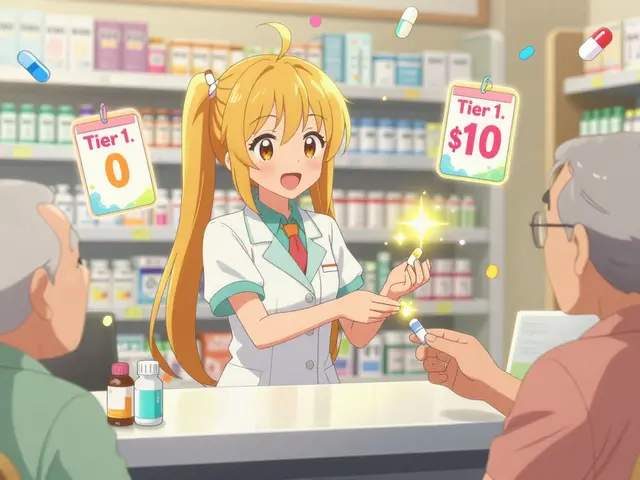
- Tier 1 (Generic): Usually $10-$15 copay. These are the cheapest, most common drugs.
- Tier 2 (Preferred Brand): Around $40. These are brand-name drugs your plan likes because they’re cost-effective.
- Tier 3 (Non-Preferred Brand): $100 or more. Your plan doesn’t push these. They’re more expensive, and you pay more.
- Tier 4 (Specialty): This is where things get serious. Coinsurance of 25-33% kicks in. A single prescription can cost over $1,000 out of pocket.
Just because your drug is on the formulary doesn’t mean you’ll get it cheap. One person on Reddit paid $3,700 for a specialty drug they thought was covered under Tier 4-only to find out their Silver plan had a $500 copay maximum, not a coinsurance cap. That’s $3,200 they didn’t budget for.
Ask: “Is my exact medication on the formulary, and what tier is it in?” Don’t just ask if it’s covered. Ask where it’s covered.
How Much Will You Pay Before Coverage Starts?
Some plans have deductibles. That means you pay 100% of your drug costs until you hit that number. For Bronze Marketplace plans, the average deductible is $6,000. That’s not a typo. You could pay $6,000 out of pocket before your insurance even starts helping with prescriptions.
Gold plans? Average deductible: $150. Platinum? Sometimes $0.
If you take multiple maintenance meds-say, three or four-a Bronze plan might save you $100 a month on premiums, but you’ll end up paying thousands more in drug costs. CMS modeling shows someone on 12 regular prescriptions saves $1,842 a year by choosing a Gold plan over a Bronze one.
Ask: “What’s the deductible for prescription drugs? Do I have to meet it before my copays kick in?” Some plans have separate medical and drug deductibles. Others combine them. Know which one you’ve got.
Are There Step Therapy or Prior Authorization Rules?
Step therapy means your plan won’t cover your prescribed drug until you try a cheaper one first. Maybe your doctor gave you a new arthritis med, but your plan says you have to try two generics first. You could wait weeks, and your pain could get worse.
Prior authorization is even more frustrating. Your doctor has to call the insurance company, fill out paperwork, and wait for approval-sometimes days-before you can even get your drug. In 2023, 28% of Medicare Part D prescriptions needed prior authorization. For specialty drugs, it’s even higher.
Ask: “Does my drug require step therapy or prior authorization? What’s the process?” If your plan requires prior auth, ask how long it usually takes. If your doctor has to submit a letter of medical necessity, find out if your plan has a form for that. Don’t assume it’s automatic.

Which Pharmacies Are In-Network?
78% of Marketplace plans restrict you to specific pharmacies. Walk into a CVS, Walgreens, or your local pharmacy-and if it’s not on the list, you pay 37% more.
Some plans only cover mail-order pharmacies for maintenance meds. Others require you to use a specific chain. One user switched to a Medicare Advantage plan thinking they’d save money-only to find out their go-to pharmacy wasn’t in-network. They paid $120 extra for a $90 prescription.
Ask: “Which pharmacies are in-network? Can I use my usual pharmacy? What if I need a drug while traveling?” Check if your plan covers out-of-network pharmacies at all-and if they do, what the cost difference is.
What About the Coverage Gap (Donut Hole) for Medicare?
If you’re on Medicare Part D, you’ve probably heard of the “donut hole.” That’s the gap between what you and your plan pay, and when catastrophic coverage kicks in.
In 2024, once your total drug costs hit $5,030, you enter the gap. You pay 25% of the cost until you hit $8,000. Then you get catastrophic coverage. But starting in 2025, the donut hole is gone. You’ll pay 25% all year, no matter how much you spend.
Also, in 2025, insulin will cost no more than $35 a month for Medicare Part D users. That’s huge if you’re on insulin.
Ask: “Is my plan affected by the 2025 changes? Will my insulin cost be capped?” Even if you’re not on Medicare now, if you’re approaching 65, these changes matter. Know how your plan will shift.
What’s the Out-of-Pocket Maximum?
This is the most you’ll pay in a year for covered drugs. After that, your plan pays 100%. For Bronze plans, it’s $9,450. For Platinum, it’s $3,050.
If you take expensive drugs, a higher premium with a lower out-of-pocket max might be smarter. One Medicare user saved $8,400 a year by switching from a low-premium plan to a Gold plan because her insulin was cheaper and her cap was lower.
Ask: “What’s the annual out-of-pocket maximum for prescriptions? Does it include my premiums?” (Spoiler: It doesn’t. Premiums are separate.)

Can You Switch Plans If Your Meds Change?
Life changes. You get a new diagnosis. Your doctor switches your med. Your current plan might not cover it.
Marketplace plans let you switch only during Open Enrollment (Nov 1-Jan 15), unless you have a qualifying life event-like losing other coverage or moving.
Medicare Part D allows you to switch once a year during the Annual Election Period (Oct 15-Dec 7). But if your drug gets removed from the formulary mid-year, you can switch plans outside that window.
Ask: “What happens if my drug is removed from the formulary next year? Can I switch plans early?” Most plans have to notify you 60 days in advance. But if you’re on a specialty drug, don’t wait. Check your formulary every fall.
How Do You Check All This?
You don’t have to guess. Use the tools.
- For Marketplace plans: Go to HealthCare.gov. Use the plan comparison tool. Enter your exact medications (by brand and generic name) and your preferred pharmacy. It shows you costs for each plan.
- For Medicare: Use Medicare.gov’s Plan Finder. Enter your drugs by NDC code (ask your pharmacist for it). It compares all Part D and Medicare Advantage plans in your area.
People who spend 20 minutes checking their meds before enrolling save an average of $1,147 a year. That’s more than a month’s premium.
What’s Changing in 2025?
The Inflation Reduction Act is reshaping prescription coverage:
- Insulin costs capped at $35/month for Medicare Part D users.
- Out-of-pocket drug costs capped at $2,000/year for Medicare beneficiaries.
- Medicare will start negotiating prices for 10 high-cost drugs in 2026, expanding to 20 by 2029.
- More plans will start using value-based design-lower copays for drugs that treat chronic conditions like diabetes or heart disease.
These changes mean the rules are shifting. What was true last year might not be true next year. Check your plan every fall. Don’t assume.
Bottom Line: Check Before You Sign
Prescription drug coverage isn’t optional. It’s essential. But it’s also complex. You can’t rely on what your agent says. You can’t trust what your friend had. You have to check your own meds.
Take 20 minutes. Write down your prescriptions. Know your pharmacy. Look up the formulary. Compare plans. Ask the questions. The money you save isn’t just dollars-it’s peace of mind.
Does every health insurance plan cover prescription drugs?
Yes, under the Affordable Care Act, all Marketplace plans must include prescription drug coverage. Employer-sponsored plans cover 85% of workers with drug benefits. Medicare Part D is also mandatory for those enrolled in Original Medicare. But ‘coverage’ doesn’t mean ‘affordable’-your specific drugs may be on a high-cost tier or require prior authorization.
How do I know if my drug is covered?
Find your plan’s formulary online, usually under ‘Drug List’ or ‘Formulary’ on your insurer’s website. Search by your drug’s generic or brand name. If you can’t find it, call customer service and ask: ‘Is [drug name] covered, and what tier is it on?’ Always confirm with your pharmacy before filling the prescription.
Why is my copay so high even though my drug is covered?
Your drug may be on Tier 3 or Tier 4, which have higher copays or coinsurance. Specialty drugs for conditions like MS or cancer often cost $1,000+ per month even with coverage. Some plans also have separate deductibles for prescriptions. Check your Summary of Benefits to see if your drug is classified as specialty or non-preferred.
Can I use my prescription drug coverage at any pharmacy?
No. Most plans limit you to a network of pharmacies. Out-of-network pharmacies often charge 30-40% more. Some plans require mail-order for maintenance drugs. Always check your plan’s pharmacy directory before filling a prescription. If you travel often, ask if your plan has a national network or emergency refill options.
What if my drug gets removed from the formulary?
Your insurer must notify you at least 60 days before removing a drug. If it’s your only option, you can request an exception or switch plans during a special enrollment period. For Medicare, you can change plans mid-year if your drug is removed. Don’t wait-start the process as soon as you get the notice.
How do I save money on prescriptions if I’m on Medicare?
In 2025, you’ll pay no more than $2,000 out of pocket for all your drugs, and insulin will cost $35/month. Until then, check if your plan offers a low-income subsidy (Extra Help), which can cut your costs by up to 75%. Also, compare Part D plans every fall-your current plan may no longer be the cheapest for your meds.
Should I pick a higher-premium plan to save on drug costs?
If you take multiple prescriptions, especially specialty drugs, yes. A Gold or Platinum plan may cost $200-$400 more per month, but your out-of-pocket drug costs could be $2,000-$5,000 lower than a Bronze plan. Use HealthCare.gov’s tool to compare total annual costs, not just premiums. The cheapest premium isn’t always the cheapest overall.


Scott Butler
December 13, 2025 AT 01:25Emma Sbarge
December 13, 2025 AT 03:46Lauren Scrima
December 13, 2025 AT 08:02Casey Mellish
December 14, 2025 AT 08:50Yatendra S
December 14, 2025 AT 09:44Himmat Singh
December 16, 2025 AT 06:23kevin moranga
December 17, 2025 AT 12:26Alvin Montanez
December 18, 2025 AT 19:13