
It’s not rare. In fact, it’s more common than most people realize. If you’re taking medication for depression, anxiety, or even high blood pressure, there’s a good chance it’s affecting your sex life. And if you’re not talking about it, you’re not alone. Studies show that between 58% and 70% of people on antidepressants experience sexual side effects-loss of desire, trouble getting or keeping an erection, delayed or absent orgasm, or even pain during sex. Yet, nearly 73% of patients never bring it up to their doctor. Why? Embarrassment. Assumption that nothing can be done. Or worse-no one ever asked.
Why This Isn’t Just a "Side Effect"-It’s a Treatment Barrier
Sexual side effects aren’t just inconvenient. They’re a major reason people stop taking life-saving medication. A national survey found that over 40% of men and 15% of women quit their psychiatric meds because of sexual problems. That’s not just a personal loss-it’s a public health issue. When someone stops taking their antidepressant because they can’t have sex, their depression often comes back. And that’s when things get dangerous. The problem isn’t the medication itself. It’s the silence around it. Most doctors don’t bring it up. Most patients don’t know what to say. And without a plan, people suffer in silence-sometimes for months.What Does Sexual Side Effect Actually Look Like?
It’s not the same for everyone. And it’s not always what you think. For men, the most common issues are:- Loss of sexual desire (reported in 62% of cases)
- Difficulty getting or keeping an erection (48%)
- Delayed or impossible orgasm (up to 50% on SSRIs)
- Painful, prolonged erection (priapism-rare, but serious, especially with trazodone)
- Loss of desire (57%)
- Pain during sex (38%)
- Difficulty reaching orgasm (at least 30%)
Which Medications Are Most Likely to Cause This?
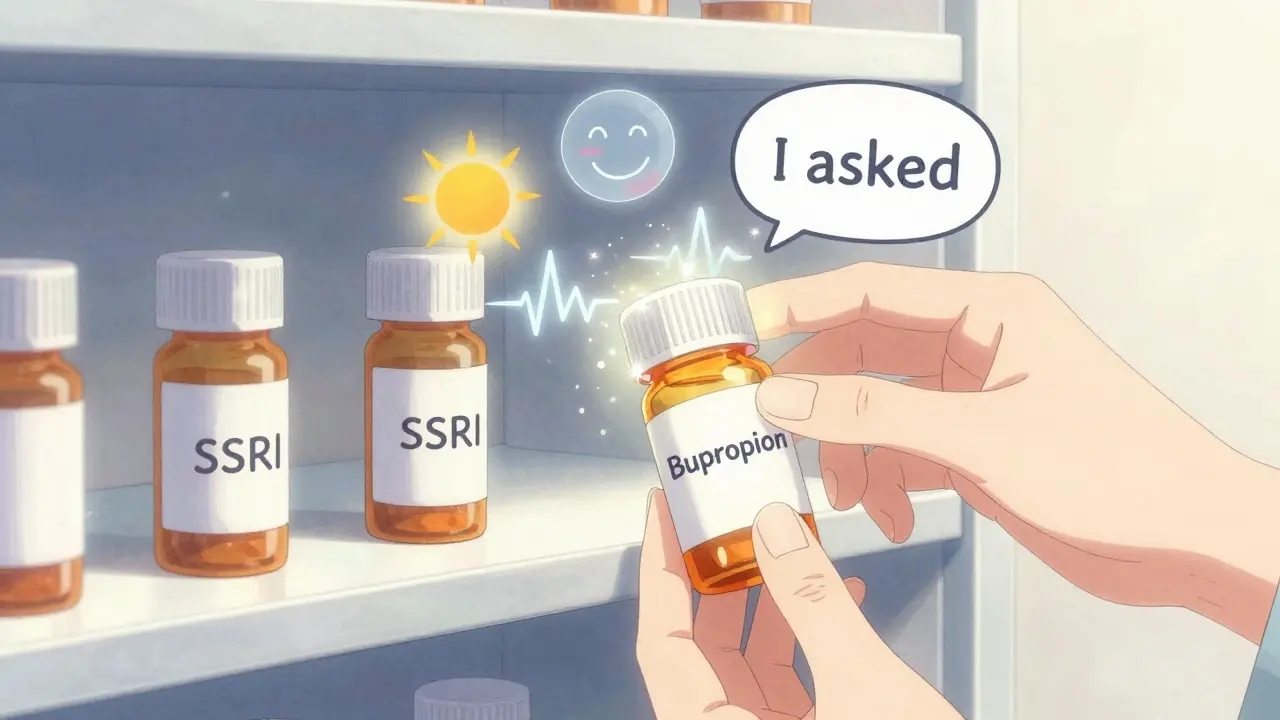
Not all drugs are created equal. Some are much more likely to mess with your sex life than others. High risk (50-70%): SSRIs like fluoxetine (Prozac), sertraline (Zoloft), and paroxetine (Paxil). These are the most commonly prescribed antidepressants-and the most likely to cause sexual side effects. Low risk (5-10%): Bupropion (Wellbutrin) and mirtazapine (Remeron). These are often recommended as alternatives for people who’ve had sexual side effects on other meds. Antipsychotics? If they raise prolactin levels (like risperidone), they can shut down libido and cause erectile issues. Switching to aripiprazole can fix this in 75% of cases. Even some blood pressure meds, like beta-blockers and diuretics, can reduce sexual function. It’s not just psychiatric drugs.
What Actually Works: Evidence-Based Solutions
There’s no one-size-fits-all fix. But there are proven strategies-and most of them don’t require you to suffer in silence. 1. Lower the dose - Sometimes, cutting the dose by 25-50% reduces side effects without losing the mood benefits. Works in 25-30% of cases. 2. Take a drug holiday - Skip your pill for 2-3 days before planned intimacy. This works in 40% of cases-but risky if you’re on short-acting meds like paroxetine. Relapse risk is 15%. 3. Switch medications - This is one of the most effective moves. Going from an SSRI to bupropion or mirtazapine helps 65-70% of people. It’s not a failure-it’s a smart adjustment. 4. Add a pill for the side effect - For men with erectile issues, sildenafil (Viagra) or tadalafil (Cialis) helps in 55-60% of cases. But it doesn’t help with low desire or delayed orgasm. And misuse is common-many people take it wrong or expect miracles. 5. Timing sex around your meds - If you take your pill in the morning, try sex in the evening when levels are lower. Simple. Free. Works for 35%. 6. Couples therapy - If the side effect is straining your relationship, therapy helps 50% of couples. It’s not about fixing sex-it’s about reconnecting. 7. Use a checklist - Ask your doctor: "Have you checked my sexual function since I started this?" Use tools like the AZ Sex Experience Scale (ASEX). It takes 5 minutes. Most clinics don’t use it. You can.Why Talking About It Changes Everything
The biggest breakthrough isn’t a new drug. It’s a conversation. Patients whose doctors brought up sexual side effects before prescribing reported 82% satisfaction with treatment. Those whose doctors never mentioned it? Only 47% were satisfied. Why? Because when your doctor says, "This happens to about 6 out of 10 people on this med," it stops feeling like a personal failure. When they say, "Here’s what we can do," it stops feeling hopeless. One patient on HealthUnlocked said: "My doctor switched me to bupropion after I mentioned sexual problems at our 6-week check-in. My sex life improved in two weeks. I’ve stayed on treatment for 18 months." That’s the power of asking-and being heard.What Your Doctor Should Be Doing (But Probably Isn’t)
According to guidelines from the American Psychiatric Association (2022), routine screening for sexual function should be part of every medication check-up. But here’s the gap:- 68% of Reddit users said their doctor never discussed it before prescribing.
- 64% of doctors report discomfort talking about sex.
- 78% of psychiatric clinics have no standard protocol.
The Bigger Picture: Why This Is Changing
This isn’t just about sex. It’s about dignity. About autonomy. About not having to choose between feeling better mentally and feeling like yourself physically. The FDA now requires clearer warnings on antidepressant labels. Telehealth companies like Ro and Hims are building specialized services just for this. Hospitals are rolling out screening tools. And in 2023, the APA added a full section to its guidelines on managing sexual side effects. The future? Experts predict that by 2030, checking for sexual side effects will be as routine as checking your weight or blood sugar. But that future depends on patients speaking up.What You Can Do Today
1. Track your symptoms. Write down what’s changed: desire, arousal, orgasm, pain. Be specific. 2. Don’t wait. If you notice changes in the first 2-4 weeks, talk to your doctor. Don’t wait 6 months. 3. Ask for alternatives. "Is there another medication with fewer sexual side effects?" Bupropion and mirtazapine are the top choices. 4. Bring a partner. If you’re in a relationship, invite them to the appointment. They might notice things you miss. 5. Use a resource. Apps like MoodFX (launched 2022) track mood and sexual function together. Over 127,000 people use it.What’s Coming Next
A new drug is in phase 3 trials (NCT04891234) designed to block the serotonin receptor that causes sexual side effects-without reducing the antidepressant effect. Results are expected in 2024. But you don’t have to wait. Right now, you have options. You have power. And you’re not the only one going through this. Sexual side effects aren’t a sign of weakness. They’re a signal. And signals can be addressed. With the right conversation, the right plan, and the right support-you don’t have to choose between mental health and a fulfilling sex life.Are sexual side effects from medications permanent?
No, they’re almost always reversible. Most side effects improve or disappear once the medication is adjusted-whether by lowering the dose, switching drugs, or adding a counter-treatment. In rare cases, like with some SSRIs, symptoms linger after stopping (called PSSD), but this affects less than 1% of users and is still being studied. The vast majority of people regain normal function with the right changes.
Can I just stop taking my medication if the side effects are too bad?
Stopping abruptly can cause withdrawal symptoms or a return of your original condition. Never stop without talking to your doctor. Instead, ask for help managing the side effects. There are almost always safer alternatives. The goal isn’t to quit-it’s to find a treatment that works for your whole life, not just your mood.
Do women experience sexual side effects differently than men?
Yes. While men often struggle with erections or delayed orgasm, women more commonly report loss of desire and pain during sex. But research on female sexual side effects lags behind-only 12% of clinical trials focus on women. This means many treatments are based on male data. That’s changing, but it’s still a gap. If you’re a woman experiencing this, your experience is valid, even if the science hasn’t caught up yet.
Is it my fault that I’m having these side effects?
Absolutely not. These are biological responses to medication, not personal failures. Over half of people on SSRIs experience them. That’s not a coincidence-it’s a predictable effect of how these drugs work. Blaming yourself only makes it harder to seek help. You didn’t do anything wrong. Your body is reacting to a chemical change. That’s not weakness. It’s physiology.
What if my doctor dismisses my concerns?
If your doctor says "It’s just part of getting better," they’re not following current guidelines. Sexual side effects are recognized as a major treatment barrier. Politely say: "I’ve read that this is common and treatable. Can we explore options?" If they still refuse, ask for a referral to a psychiatrist or sexual health specialist. You deserve care that respects your whole self-not just your mood.
Can counseling help even if I’m not on medication?
Yes. Sexual dysfunction can come from many sources-stress, relationship issues, past trauma, or even untreated depression. Counseling doesn’t just fix medication side effects. It helps you understand your body, communicate with partners, and rebuild confidence. Whether you’re on meds or not, working with a therapist trained in sexual health can make a real difference.
Are there natural remedies that work for medication-induced sexual side effects?
There’s no strong evidence that supplements like ginseng, L-arginine, or maca reliably fix medication-induced sexual side effects. Some may help with general libido, but they don’t counteract the specific biological changes caused by SSRIs or other drugs. Don’t waste money or time on unproven fixes. Focus on evidence-based strategies: dose changes, switching meds, timing sex, or therapy. These have real data behind them.
How long does it take for sexual side effects to go away after switching meds?
It varies. Some people notice improvement in days-especially if switching to bupropion. Others take 2-6 weeks as their body adjusts. Don’t expect instant results. Give it time. Track your progress. And if nothing improves after 6 weeks, talk to your doctor again. You might need another adjustment.

Tola Adedipe
February 7, 2026 AT 14:22Bro. I was on Zoloft for 3 years. Lost all libido, couldn't even get hard watching porn. Thought I was broken. Then I switched to Wellbutrin. Boom. Sex drive back. Not just back-*better* than before. My wife noticed. I noticed. My therapist noticed. Stop suffering. Talk to your doc. There are options. Don't let shame kill your life.
Niel Amstrong Stein
February 9, 2026 AT 01:58Man. I just want to say… this is the kind of post that makes me believe the internet isn’t all trash. 🙏
Used to think my low libido was "just me"-turns out it was the SSRI. Switched to mirtazapine. Took 3 weeks. Now I can actually enjoy intimacy again. Not just "do it"-but *want* to. That’s huge.
Also, the checklist? Genius. I printed it. Gave it to my doc. He actually read it. Wild.
Thanks for saying this out loud.
Joey Gianvincenzi
February 9, 2026 AT 16:37As a licensed psychiatrist, I must emphasize: the data presented here is clinically accurate and aligns with APA 2022 guidelines. However, the casual tone of this post may inadvertently trivialize the gravity of treatment non-adherence. Sexual side effects are not merely "inconvenient"-they are a documented cause of increased suicide risk in depressed patients who discontinue medication. We must treat this with clinical rigor, not internet memes.
Marcus Jackson
February 11, 2026 AT 04:45Let’s be real. The real issue isn’t the meds. It’s that doctors are lazy. They don’t want to talk about sex. So they prescribe SSRIs like candy. Then act shocked when patients quit.
Here’s the truth: every single one of these side effects is predictable. Every. Single. One.
And if your doc doesn’t bring it up before prescribing? Fire them. Seriously. Find someone who treats your whole body-not just your mood.
Natasha Bhala
February 11, 2026 AT 12:37Jesse Lord
February 11, 2026 AT 18:30My girlfriend and I went to couples therapy because of this. We thought it was about us. Turns out it was about the Paxil.
Therapist said something I’ll never forget: "Sex isn’t broken. The medicine is."
That changed everything. We stopped blaming each other. Started working with the doc. Now we’re on bupropion. And yeah… we’re back.
It’s not magic. But it’s possible.
Catherine Wybourne
February 13, 2026 AT 10:13Oh honey, this is why I always say: "If your doctor doesn’t ask about your sex life, they’re not your doctor-they’re a vending machine for pills."
Also, the fact that 64% of docs are "uncomfortable"? That’s not a medical issue. That’s a cultural one.
And we need to fix the culture before we fix the meds.
Amit Jain
February 14, 2026 AT 18:27Ugh. This is why I hate American medicine. You get a pill for everything. Then you’re surprised when it breaks your sex life? No one ever told you to try therapy first? Or yoga? Or fasting? Or just… stop being so emotionally dependent?
Maybe if you stopped taking antidepressants and started living, you wouldn’t need to fix your sex life with Viagra.
Just saying.
Sarah B
February 15, 2026 AT 09:28So let me get this straight. We’re supposed to talk to our doctors about sex? Like… actually say the words? Out loud? In a room? With a white coat?
That’s why America’s collapsing. No one can handle real talk anymore. Just give me a pill and shut up.
Eric Knobelspiesse
February 16, 2026 AT 05:03Interesting. But let’s zoom out.
Is the real problem the medication… or the fact that we’ve reduced intimacy to a biological function that needs "fixing"?
What if the loss of desire isn’t a side effect… but a signal?
Maybe your body’s saying: "This isn’t the life you were meant to live."
Just a thought. I’m not saying stop meds. I’m saying… maybe look deeper.
Heather Burrows
February 18, 2026 AT 03:37I just don’t get how people can be so casual about this. Medication is a serious thing. You don’t just switch pills like you switch Netflix accounts.
And what about the people who actually need SSRIs? Are we just supposed to trade mental health for better orgasms?
It’s irresponsible to frame this as a simple fix.
Some things are worth suffering for.
Ritu Singh
February 18, 2026 AT 15:57As an Indian woman who’s been on sertraline for 5 years, I can confirm: the cultural silence is even worse here.
No one talks about this. Not even your closest friends. I cried for weeks before I told my doctor.
Switching to mirtazapine was the best decision I ever made.
To any woman reading this: your desire is valid. Your pain is real. And you deserve to feel whole again.
Mark Harris
February 19, 2026 AT 11:46STOP. JUST STOP.
YOU CAN DO THIS.
YOU’RE NOT BROKEN.
YOUR BODY ISN’T FAILING YOU.
YOUR DOCTOR JUST HASN’T BEEN TAUGHT HOW TO HELP.
SO BE THE ONE WHO ASKS.
JUST SAY IT.
"I’M NOT GETTING OFF ON THIS MED. WHAT CAN WE DO?"
AND THEN-
WAIT FOR THE ANSWER.
IT’S THERE.
YOU GOT THIS.
Mary Carroll Allen
February 19, 2026 AT 12:55I’ve been on 4 different meds. Lost my sex life. Got it back. Lost it again. Got it back.
Here’s what I learned: it’s not about the drug. It’s about the *timing*.
My doc had me try sex at 10pm instead of 8am. Took 3 days. Boom.
Also, I started using MoodFX. Tracking my mood and libido together. Shocking how connected they are.
Don’t give up. It’s trial and error. But you’re not alone.
Paula Sa
February 20, 2026 AT 17:17Thank you for writing this. I’ve been silent for two years. I thought I was broken. I thought I was selfish for caring. But I didn’t want to lose my connection with my partner. So I asked. Just one question: "Can we talk about this?"
My doctor looked surprised. Then said, "I’m so glad you brought this up."
Switched to bupropion. Two weeks later, I cried because I felt like myself again.
You’re not alone. And you’re not weak. You’re brave.