
Standing up and feeling like the room is spinning? That sudden wave of dizziness, blurred vision, or even blacking out isn’t just bad luck-it could be your medications. This isn’t normal aging. It’s orthostatic hypotension, and it’s one of the most common, preventable side effects of drugs taken by millions of older adults every day.
What Exactly Is Orthostatic Hypotension?
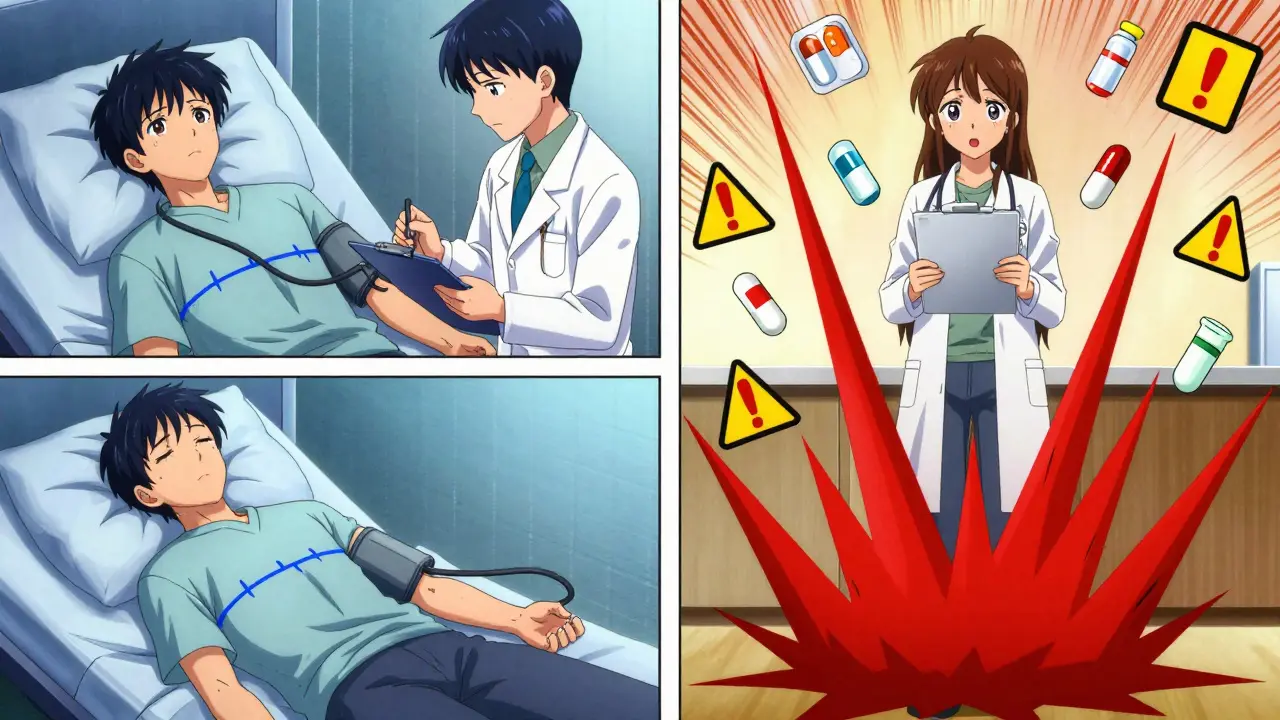
Orthostatic hypotension, also called postural hypotension, happens when your blood pressure drops too much when you stand up. The medical definition is simple: a systolic drop of 20 mm Hg or more, or a diastolic drop of 10 mm Hg or more, within three minutes of standing. That’s not a minor dip-it’s enough to starve your brain of blood, causing dizziness, lightheadedness, or fainting.It’s not just about feeling a little woozy. When your blood pressure crashes on standing, your body can’t pump enough oxygen to your brain fast enough. That’s why people describe it as feeling like they’re going to pass out. In some cases, they do.
Why Medications Are the Top Culprit
While dehydration, heart problems, or nerve damage can cause orthostatic hypotension, drugs are the most common reason-especially in people over 70. Up to 30% of all cases are directly tied to medications. And it’s not just one or two pills. It’s the combo.Here are the drug classes most likely to trigger it:
- Antihypertensives (blood pressure meds): Diuretics like hydrochlorothiazide, ACE inhibitors like lisinopril, and calcium channel blockers all lower blood pressure too aggressively when you stand.
- Alpha-blockers: Used for prostate issues or high blood pressure, drugs like doxazosin and terazosin relax blood vessels too much. Risk jumps 2.8 times compared to people not taking them.
- Tricyclic antidepressants: Amitriptyline, nortriptyline-these affect nerve signals that control blood pressure. Risk increases 3.2 times.
- Antipsychotics: Chlorpromazine, clozapine, quetiapine. These can blunt your body’s natural response to standing. Up to 40% of people on high doses experience it.
- Opioids: Morphine, oxycodone, hydrocodone. They depress the nervous system, making it harder for your body to adjust. Risk spikes 2.3 times if taken with alcohol or benzodiazepines.
- Levodopa: Used for Parkinson’s, it causes OH in 30-50% of users.
One patient on Reddit shared: “After starting quetiapine for anxiety, I fainted twice within three weeks. My blood pressure dropped from 128/82 to 92/61 in under two minutes.” That’s not rare. It’s textbook.
Who’s Most at Risk?
It’s not just about the drugs-it’s who’s taking them.- Age 70+: Your body’s ability to regulate blood pressure slows down. People over 70 are 3.2 times more likely to develop OH than younger adults.
- On four or more medications: The risk jumps 5.7 times. Polypharmacy isn’t just a buzzword-it’s a danger zone.
- People with diabetes, Parkinson’s, or heart disease: These conditions already weaken your autonomic nervous system. Medications push it over the edge.
- Dehydrated or bedridden: Low blood volume makes it harder to compensate when standing.
Many patients don’t realize their dizziness is drug-related. A Mayo Clinic study found 55% of people had symptoms for over two months before anyone connected the dots. That’s too long to risk a fall.
Why This Isn’t Just an Annoyance
Feeling dizzy when you stand up sounds minor. But the consequences are serious.- Falls: People with OH have a 15-30% higher risk of falling. For older adults, a single fall can mean a broken hip, surgery, long-term care, or death.
- Increased mortality: Studies show a 24-32% higher risk of dying over 10 years if you have persistent orthostatic hypotension.
- Cognitive decline: Repeated drops in brain blood flow may contribute to memory problems and dementia over time.
- Hospitalizations: OH-related falls cost Medicare $31 billion in 2022 alone. Up to 40% of those costs are tied to medications.
It’s preventable. But only if we treat it like the red flag it is.
How Doctors Diagnose It
It’s not guesswork. Diagnosis requires measuring blood pressure properly.Here’s the standard protocol:
- Rest in a lying position for five minutes.
- Measure blood pressure and heart rate.
- Stand up slowly.
- Measure again at one, two, and three minutes after standing.
A drop of 20/10 mm Hg or more at any point during those three minutes confirms orthostatic hypotension. And symptoms must match. Some people have the drop but no dizziness-others feel awful with only a small dip. Both matter.
Doctors now know to check this routinely. The American Geriatrics Society’s Beers Criteria lists 12 high-risk medications for seniors. Most U.S. primary care practices now screen for OH in patients over 65.
What You Can Do Right Now
If you’re dizzy on standing, don’t just tough it out. Here’s what works:- Review your meds: Ask your doctor: “Could any of these be causing my dizziness?” Bring a full list-prescriptions, supplements, even over-the-counter painkillers.
- Slow down: Sit on the edge of the bed for a full minute before standing. Use a handrail. Don’t rush.
- Hydrate: Drink 2-2.5 liters of water daily. Dehydration makes OH worse. A glass of water before standing can help.
- Compression stockings: These help push blood back up from your legs. Not glamorous, but effective.
- Don’t stand still: If you’re standing for a while, shift your weight, wiggle your toes, or march in place. Movement keeps blood flowing.
- Avoid alcohol and hot showers: Both dilate blood vessels and make dizziness worse.
One patient on Cleveland Clinic’s forum wrote: “My 78-year-old mom was falling constantly. She was on six meds. We stopped hydrochlorothiazide. Within 72 hours, she stopped feeling dizzy. No more falls.”

When Medication Changes Are Needed
Sometimes, you can’t just stop a drug. But you can often adjust it.- Lower the dose: Sometimes half a pill is enough.
- Switch to a safer alternative: For example, ziprasidone has only 5-10% OH risk, compared to clozapine’s 35-45%.
- Change timing: Take blood pressure meds at night if possible, so the peak effect isn’t during morning standing.
- Use midodrine: If non-drug fixes don’t help, this medication helps tighten blood vessels. It’s approved for OH and helps 65% of patients.
Studies show 65-80% of patients improve significantly within one to two weeks of adjusting meds. That’s not a miracle-it’s good medicine.
The Bigger Picture
Orthostatic hypotension isn’t a disease. It’s a warning sign. A sign that your body’s natural systems are being overwhelmed by the very drugs meant to help you.By 2030, the number of Americans over 65 will hit 80 million. More meds. More OH. More falls. More costs. The healthcare system is waking up-screening is up 45% since 2018. But it’s still not routine enough.
The future is coming: drug companies are developing new medications designed to avoid OH. Some are testing alpha-1A selective agonists that tighten blood vessels without overdoing it. But for now, the solution is simple: know your meds. Know your symptoms. Ask the question.
You don’t have to live with dizziness when you stand up. It’s not normal. And it’s not inevitable.
Can orthostatic hypotension go away on its own?
Yes, if it’s caused by medication. In 70-85% of cases, symptoms improve or disappear after adjusting, reducing, or stopping the drug. But if it’s caused by nerve damage from diabetes or Parkinson’s, it’s less likely to resolve without treatment. The key is identifying the cause.
What should I do if I feel dizzy when standing?
Sit or lie down immediately. Don’t try to push through it. Then, write down when it happened, what you were doing, and how long it lasted. Bring this info to your doctor. Don’t wait-this isn’t just about discomfort. It’s about preventing a fall.
Are there any supplements that help with orthostatic hypotension?
Some people report mild improvement with increased salt intake or licorice root, but these aren’t proven and can be dangerous-especially with heart or kidney problems. Don’t self-treat. Talk to your doctor. The safest and most effective strategies are hydration, compression stockings, and medication review.
Can I still drive if I have orthostatic hypotension?
It depends. If you’ve had fainting episodes or frequent dizziness, driving is risky. Many states require reporting medical conditions that affect safe driving. If your symptoms are controlled-no fainting, no dizziness for weeks-you may be cleared. Always check with your doctor and local DMV rules.
Why don’t doctors always catch this?
Because patients often don’t mention it. They think dizziness is just part of getting older. Or they’re embarrassed. Doctors may not ask unless symptoms are severe. That’s why it’s critical to speak up. If you feel dizzy on standing, say it. Bring up your meds. Your doctor needs that info to help you.
Next Steps: What to Ask Your Doctor
Don’t leave this to chance. Here’s what to say at your next appointment:- “I’ve been feeling dizzy when I stand up. Could any of my medications be causing this?”
- “Can we review all my meds-prescriptions, supplements, OTC-to see if any are high-risk for low blood pressure?”
- “Can we check my blood pressure lying down and then standing up during this visit?”
- “Is there a safer alternative to this drug that won’t make me dizzy?”
- “Should I be wearing compression stockings or increasing my water intake?”
Orthostatic hypotension isn’t something you have to live with. It’s a signal. Listen to it. Adjust. Protect yourself. Your next step might be the one that keeps you standing-safely-for years to come.
kate jones
January 29, 2026 AT 18:44Orthostatic hypotension is a classic iatrogenic syndrome, especially in polypharmacy patients over 70. The autonomic nervous system's baroreflex arc becomes attenuated with age, and when you layer on alpha-blockers or tricyclics, you're essentially disabling compensatory vasoconstriction. It's not 'just dizziness'-it's a neurocardiogenic failure event waiting to happen. Always check orthostatics before escalating antihypertensives in geriatric populations.
Natasha Plebani
January 30, 2026 AT 00:03There's a philosophical irony here: we medicate to extend life, yet the very tools we use to stabilize chronic conditions-beta-blockers, diuretics, antidepressants-undermine the body's innate homeostatic mechanisms. Orthostatic hypotension isn't a side effect; it's the body screaming that the system it's trying to regulate has been hijacked by pharmacology. We treat numbers, not people.
Kelly Weinhold
January 31, 2026 AT 12:47OMG I’m so glad someone wrote this. My mom was falling all the time and we thought it was just ‘getting old’ until her PCP actually checked her BP standing up. She was on hydrochlorothiazide, lisinopril, and amitriptyline-three of the worst offenders. We cut the HCTZ and halved the amitriptyline. She hasn’t fallen in 6 months. She’s back to gardening, walking the dog, even dancing with her grandkids. It’s not magic-it’s just listening to your body. You deserve to stand up without feeling like you’re gonna pass out.
Kimberly Reker
February 1, 2026 AT 17:04Biggest takeaway? Don’t ignore dizziness. It’s not ‘normal aging.’ I’ve seen too many elderly patients dismissed as ‘just clumsy’ when the real issue is a drug cocktail that’s too aggressive. Compression socks are underrated-cheap, non-pharm, and actually work. And hydration? More than just water. Electrolytes matter too, especially if you’re on diuretics. Talk to your doctor, bring your med list, and don’t let anyone tell you it’s just part of getting older.
Eliana Botelho
February 2, 2026 AT 02:54Ugh, this is such a biased post. All this fearmongering about meds? What about the fact that people with hypertension die from strokes if they don’t take their pills? You’re acting like every BP med is poison. I’m on quetiapine for bipolar and I’ve never fainted. My doctor monitors me. Maybe the problem isn’t the drugs-it’s lazy prescribing and patients who don’t follow up. Stop blaming pharmaceuticals and start taking responsibility.
Rob Webber
February 3, 2026 AT 14:22This is why medicine is broken. You write a 2000-word essay on orthostatic hypotension and still don’t say the real truth: doctors don’t care. They prescribe like they’re on an assembly line. They don’t check orthostatics. They don’t review med lists. They don’t even ask if you feel dizzy. They just write the script and move on. This isn’t about science-it’s about profit and volume. And now you want me to thank you for pointing out the obvious? Pathetic.
calanha nevin
February 4, 2026 AT 23:30Orthostatic hypotension is underdiagnosed and undertreated. The American College of Cardiology recommends screening in all patients over 65 on antihypertensives. Yet fewer than 20% of primary care visits include orthostatic BP measurement. The gap between guideline and practice is not just a failure of education-it is a failure of systems. If you are on four or more medications, request this test. It takes 90 seconds. It could save your life.
Lisa McCluskey
February 5, 2026 AT 22:55I’ve seen this in my clinic for 20 years. The moment a patient says ‘I get dizzy when I stand’ I know it’s either meds, dehydration, or both. We check BP lying and standing every time. If the drop is over 20/10, we adjust. No drama. No waiting. Simple. Safe. Effective. Why is this so hard for people to believe? It’s not rocket science. It’s basic physiology.
owori patrick
February 7, 2026 AT 04:05This is very important for elderly people. In Nigeria, many older folks take traditional herbs with their prescription drugs. No one tells them about interactions. I once had a patient on lisinopril and bitter leaf tea-he collapsed twice. We stopped the tea and lowered the dose. He’s fine now. Always tell your doctor everything you take, even if it’s ‘just herbal.’
Claire Wiltshire
February 7, 2026 AT 12:24Thank you for this comprehensive and clinically accurate overview. The emphasis on medication review and non-pharmacological interventions such as hydration and compression stockings is both evidence-based and patient-centered. I routinely counsel my geriatric patients using these exact strategies. Early identification and intervention significantly reduce fall-related morbidity and mortality. This is the kind of content that empowers patients and transforms clinical practice.
Darren Gormley
February 8, 2026 AT 14:24Bro this post is like 90% fear and 10% science 🤡 I’ve been on 7 meds for 8 years and I’ve never fainted. You’re just trying to make people paranoid so they stop taking their BP pills and then they get a stroke and you get to say ‘I told you so.’ Also, why no mention of salt? Salt helps. But you hate salt because you’re a wellness cultist. 🙄
Mike Rose
February 9, 2026 AT 06:55all this stuff about meds makin u dizzy. i just thought i was old. i mean i get lightheaded when i stand up. so what? i dont even know what half these drug names are. i just take em. my doc says its fine. so i dont care. maybe i should drink more water tho. 🤷♂️
Russ Kelemen
February 10, 2026 AT 19:59There’s a quiet revolution happening in geriatric care. We’re moving from ‘treat the number’ to ‘treat the person.’ Orthostatic hypotension is one of the clearest examples of why that shift matters. It’s not about eliminating meds-it’s about optimizing them. Slowing down, hydrating, standing with support-these aren’t hacks. They’re acts of respect for the aging body. You don’t need a new drug. You need awareness. And a little patience.
Diksha Srivastava
February 11, 2026 AT 01:26This is so important! In India, many elders take multiple medicines without proper monitoring. I’ve seen grandmas faint while walking to the kitchen. No one connects it to blood pressure meds. We need more awareness in rural areas too. Thank you for writing this. I’m sharing it with my family and my community group.
kate jones
February 11, 2026 AT 07:01Replying to @7335: You’re right that antihypertensives save lives-but that doesn’t mean we shouldn’t minimize harm. The goal isn’t to stop treatment; it’s to optimize dosing and timing. A 50% reduction in hydrochlorothiazide can eliminate orthostatic symptoms while preserving BP control. It’s not fearmongering-it’s precision medicine. And yes, quetiapine is safer in low doses, but 400mg daily? That’s a different risk profile.