
Imagine trying to eat a sandwich, but every bite feels like swallowing sand. Your eyes burn all day, even after using eye drops. You wake up with a cotton mouth, and drinking water doesn’t help. For millions of people, this isn’t just inconvenience-it’s daily life with Sjögren’s Syndrome.
What Exactly Is Sjögren’s Syndrome?
Sjögren’s Syndrome is an autoimmune disease where your immune system turns against your own body. Instead of fighting germs, it attacks the glands that make moisture-mainly the tear and saliva glands. This leads to the two most common symptoms: dry eyes and dry mouth. But it doesn’t stop there.
First described in 1933 by Swedish doctor Henrik Sjögren, the condition was long dismissed as just “old age” or “stress.” Today, we know better. About 4 million Americans live with it, and 90% of them are women, usually diagnosed between ages 45 and 55. It’s one of the most common autoimmune diseases in the U.S., yet most people-doctors included-don’t recognize it right away.
There are two types: primary Sjögren’s, where it stands alone, and secondary Sjögren’s, which happens alongside other autoimmune diseases like rheumatoid arthritis or lupus. About half of all cases fall into the secondary category.
It’s Not Just Dry Eyes and Dry Mouth
People often think Sjögren’s is just about being uncomfortable. It’s not. The immune system attacks more than just glands. It can affect your joints, skin, lungs, kidneys, nerves, and even your brain.
- Joint pain: About 30-50% of patients report achy, swollen joints-often mistaken for arthritis.
- Extreme fatigue: Seven out of ten people say they’re constantly exhausted, no matter how much they sleep.
- Brain fog: Trouble finding words, forgetting names, losing focus during meetings-this isn’t just stress. It’s a real neurological effect.
- Skin and vaginal dryness: Up to 20% get dry, itchy skin. Half of women experience vaginal dryness, which can wreck relationships and self-esteem.
- Nerve damage: Tingling, burning, or numbness in hands and feet affects 10-15% of patients.
- Lung issues: A persistent dry cough? That’s not allergies. About 25% develop lung inflammation.
These symptoms don’t show up all at once. They creep in slowly. One person might have dry eyes for years before noticing their mouth is always parched. Another might start with joint pain and only later realize their eyes are burning. That’s why it takes an average of 2.8 years to get diagnosed.
Why Is It So Hard to Diagnose?
Sjögren’s is called the “great imitator.” Its symptoms look like everything else: allergies, menopause, stress, aging, even dehydration.
One Reddit user, DryEyes2020, visited four doctors over three years. Her primary care doctor said it was allergies. The ENT thought it was acid reflux. Her dentist blamed her for not drinking enough water. Sound familiar?
Doctors don’t always test for it because they don’t expect it. The American College of Rheumatology says you need at least three months of persistent dryness before testing. And even then, the tests aren’t simple.
Diagnosis requires:
- Schirmer’s test: A strip of paper placed under your lower eyelid to measure tear production. Less than 5mm in 5 minutes? That’s a red flag.
- Salivary flow test: You spit into a cup for 15 minutes. Less than 1.5mL? Your glands aren’t working right.
- Blood tests: Looking for anti-SSA/Ro and anti-SSB/La antibodies. About 60-70% of patients have them.
- Salivary gland biopsy: A tiny sample from the inside of your lip checks for immune cell clusters-a hallmark of Sjögren’s.
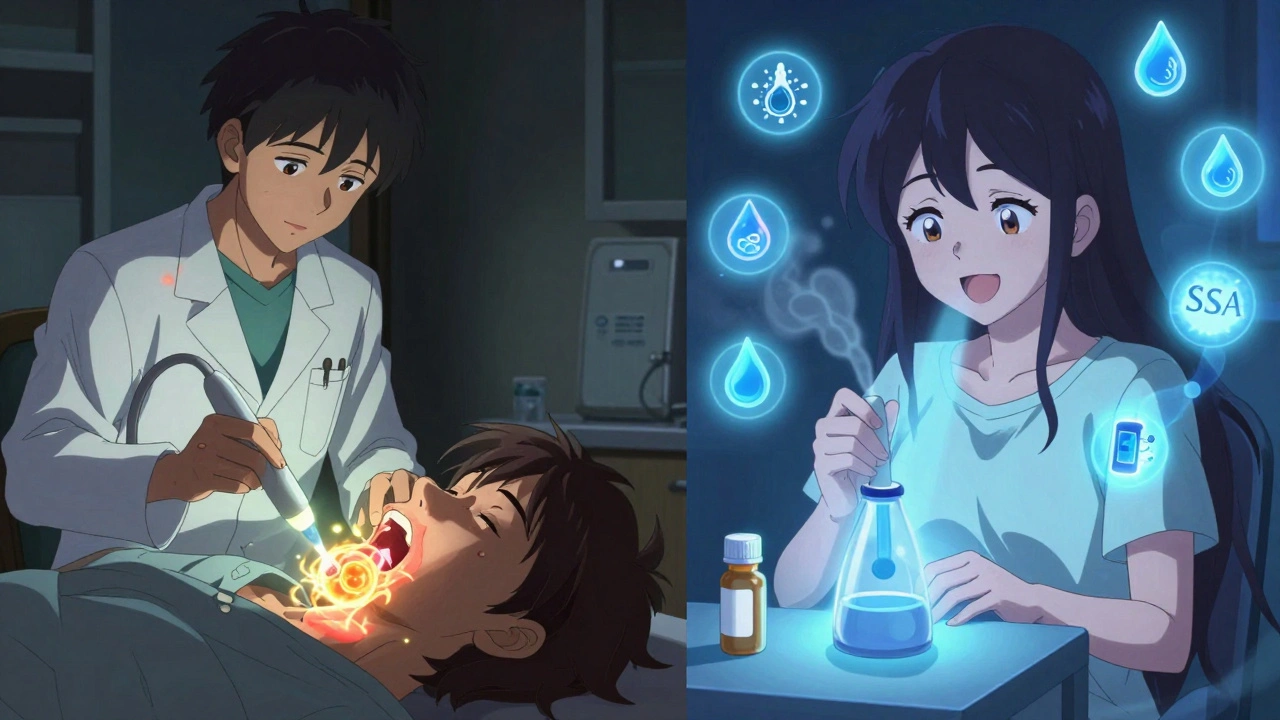
And now, newer tools are helping. In 2022, the European League Against Rheumatism added salivary gland ultrasound to the diagnostic criteria. It’s non-invasive, quick, and detects inflammation with 85% accuracy.
What Happens If It’s Left Untreated?
Ignoring Sjögren’s isn’t just about discomfort. The longer your glands are under attack, the more damage they take. Dry mouth means less saliva to wash away bacteria. That’s why people with Sjögren’s have 5-10 times the risk of cavities. Many lose teeth by their 50s.
Chronic dry eyes can lead to corneal ulcers and vision loss. Lung inflammation can cause scarring. Nerve damage can become permanent.
And then there’s the big one: lymphoma. About 4-5% of Sjögren’s patients develop non-Hodgkin lymphoma over their lifetime. That’s ten times higher than the general population. It’s rare, but it’s real. That’s why regular check-ups with a rheumatologist matter.
How Is It Treated? (And What Actually Works)
There’s no cure. But there are ways to manage it-and many patients find relief.
For dry eyes: Preservative-free artificial tears are the first line. Use them 8-10 times a day. Some patients need prescription drops like cyclosporine (Restasis) or lifitegrast (Xiidra) to reduce inflammation.
For dry mouth: Sugar-free gum, sipping water, and saliva substitutes help-but they’re temporary. Prescription drugs like pilocarpine (5mg three times a day) or cevimeline (30mg three times a day) can actually stimulate your glands to produce more saliva. About 60-70% of people notice improvement.
For joint pain and fatigue: Hydroxychloroquine (Plaquenil) is used in 40-50% of cases. It helps about a third of patients. For more severe systemic symptoms, doctors may use biologics like rituximab-though these are still being studied for Sjögren’s.
In June 2023, the FDA approved the first new Sjögren’s drug in 20 years: Efgartigimod (Vyvgart Hytrulo). In trials, it improved dry mouth symptoms by 35% compared to placebo. It’s not a cure, but it’s a major step forward.
Dental care is critical: You need to see your dentist every 3-4 months, not every 6. Fluoride treatments, special toothpaste, and strict hygiene can prevent tooth loss.
Environmental fixes: Use a humidifier. Keep your home at 40-60% humidity. Avoid fans blowing directly on your face. Stay away from dry, windy places. Drink water constantly-even if you’re not thirsty.
Complementary approaches: Omega-3 supplements help reduce inflammation. Acupuncture helps some with pain and fatigue. But these aren’t replacements-they’re supports.
Who Gets It? And Why?
It’s not random. Women are 9 times more likely to get it than men. Most are diagnosed in their late 40s. Caucasians are diagnosed more often, but underdiagnosis in Black, Hispanic, and Asian populations is likely.
Genetics play a role. Certain gene variants make you more susceptible. But something else has to trigger it. Viruses like Epstein-Barr or hepatitis C are suspects. Stress, hormones, and environmental toxins may also contribute.
It’s not inherited directly, but if a close relative has an autoimmune disease, your risk goes up. That’s why doctors now screen family members if one person is diagnosed.

What’s New in Research?
Things are changing fast.
In 2023, researchers identified a unique T-cell signature found in 78% of primary Sjögren’s patients. That could lead to a simple blood test for early diagnosis.
The NIH launched the Sjögren’s Precision Medicine Network, tracking 5,000 patients to match treatments to individual biomarkers. One study found that patients with anti-SSB/La antibodies have 3.2 times higher risk of serious complications.
The Sjögren’s Syndrome Foundation just launched TARGET, a $15 million project to find genetic markers that predict how the disease will progress.
Twelve new drugs are in clinical trials. Most target B-cells-the immune cells that go rogue in Sjögren’s. The hope is that within five years, we’ll have treatments that stop the disease, not just its symptoms.
Living With It: The Real Daily Struggles
People with Sjögren’s don’t just manage symptoms-they manage their identity.
One woman on MySjogrensTeam said it took 18 months to find a gynecologist who understood vaginal dryness was part of her disease. Another said her coworkers thought she was “lazy” because she couldn’t focus in meetings.
Depression affects 42% of patients-more than five times the national average. That’s not just sadness. It’s grief over lost normalcy.
But there’s hope. People who find the right team-rheumatologist, ophthalmologist, dentist, and support group-learn to thrive. They carry water bottles. They use lip balm. They schedule breaks. They say no to dry snacks. They find joy in small wins: eating a sandwich without choking, blinking without pain, sleeping through the night.
Life expectancy? Most people live just as long as anyone else. But quality of life? That’s the real battle.
Where Do You Go From Here?
If you’ve been told it’s “just stress” or “you’re getting old,” and you still have dry eyes, dry mouth, fatigue, or joint pain-push for more. Ask for blood tests. Ask for a referral to a rheumatologist.
Use the Sjögren’s Syndrome Foundation’s free symptom tracker. Join their online community. Talk to others who get it.
You’re not alone. And you’re not imagining it. Sjögren’s Syndrome is real. It’s common. And it’s treatable-if you get the right care.

Eddie Bennett
December 10, 2025 AT 18:37Been living with this for 7 years. The worst part isn't the dry mouth or the burning eyes-it's when your own family thinks you're just being dramatic. I once had my sister tell me to 'stop being so sensitive' because I cried during a movie. I wasn't sad-I couldn't blink without pain. People don't get it until they're in it.
Vivian Amadi
December 12, 2025 AT 00:12Ugh. Another post about 'invisible illness.' I've had dry eyes since I was 12. Guess what? I didn't need a 3000-word essay to tell me to drink more water. This is just clickbait dressed up as medical advice.
Jimmy Kärnfeldt
December 13, 2025 AT 18:18Hey, I just want to say-this post is a lifeline for people who’ve been gaslit by doctors for years. I was told my fatigue was 'just anxiety' for 4 years. When I finally got diagnosed, I cried in the parking lot. Not because I was sad-because I finally had a name for the storm inside me.
Jim Irish
December 14, 2025 AT 17:26Thank you for sharing this. The medical community has failed too many people with Sjögren's. Diagnosis delays are unacceptable. We need better training for primary care providers. Early detection saves organs.
Taylor Dressler
December 16, 2025 AT 05:14Correcting a common misconception: Efgartigimod isn't a cure. It's a FcRn blocker that reduces autoantibodies. It helps dry mouth in some, but doesn't touch nerve damage or lung involvement. Still, it's the first real step forward since hydroxychloroquine became standard in the 90s.
Aman deep
December 17, 2025 AT 07:42Bro I felt this in my bones. My grandma had Sjögren’s and she’d whisper ‘I’m not old, I’m broken’ every time she licked her lips to swallow her pills. We didn’t know what it was back then. Now I carry saline spray in my pocket like a lifeline. You’re not alone. We’re all just trying not to choke on our own bodies.
Katherine Liu-Bevan
December 17, 2025 AT 20:51For anyone reading this and thinking ‘I don’t have it because I’m young’-I was diagnosed at 29. Symptoms started at 23. If you have persistent dryness, fatigue, or brain fog for more than 3 months, push for anti-SSA/SSB tests. Don’t wait for a biopsy. Don’t wait for your doctor to notice. You’re the expert on your body.
Jean Claude de La Ronde
December 19, 2025 AT 06:34so like... if my eyes feel like sandpaper and my tongue is a desert cactus... is this the same thing as being hangry after a 14-hour Zoom call? or do i need to see a rheumy? also why is it called sjogrens and not 'my body hates me syndrome'?
Aidan Stacey
December 20, 2025 AT 22:06Let me tell you about the time I tried to eat a taco at a family BBQ. I couldn’t swallow. My mouth was so dry I thought I’d swallowed a sock. My cousin laughed and said, 'You need to hydrate, bro.' I didn’t cry. I just put the taco down and walked away. That’s the moment I knew I was living in a body that didn’t belong to me anymore. And I’m not asking for pity. I’m asking for recognition.
Mia Kingsley
December 21, 2025 AT 10:36Okay but why is this only in women? I’m a dude with dry eyes and I’m not getting diagnosed? Is this just a ‘women are weak’ medical bias? Also, I think this is just a fancy name for dehydration. I drink less water than my houseplant and I’m fine.
Monica Evan
December 21, 2025 AT 21:41My dentist found my Sjögren’s before my doctor did. I went in for a cavity and she said 'You’ve got Sjögren’s. I’ve seen this a hundred times.' She handed me a pamphlet and a tube of fluoride toothpaste. I cried in the parking lot. Doctors overlook the obvious because they’re trained to look for the exotic. Don’t wait for a specialist. Your dentist might save you.
Kristi Pope
December 22, 2025 AT 07:22For those feeling alone-there’s a whole community out here. I used to hide my water bottle like it was shameful. Now I carry three. I wear lip balm like perfume. I say ‘I have Sjögren’s’ instead of ‘I’m just tired.’ It’s not weakness. It’s survival. And you’re doing better than you think.
john damon
December 22, 2025 AT 16:29OMG I have this!!! 🥺💧 I carry a mini humidifier to work and I cry every time I eat something crunchy. Also I just found out my mom has it too 😭
Ariel Nichole
December 24, 2025 AT 11:52Just wanted to say thank you for writing this. I’ve been waiting years for someone to explain this clearly. I’m not lazy. I’m not anxious. I’m not imagining it. I have a disease that no one sees. And now I have words to give my doctor. That means everything.
Courtney Blake
December 26, 2025 AT 00:02Let’s be real-this is just another way for pharma to sell more drugs. The real solution is drinking water, using a humidifier, and not being a hypochondriac. Also, why is everyone on here acting like this is a tragedy? It’s not cancer. People have it worse.