
When you pick up a generic pill at the pharmacy, you expect it to work just like the brand-name version. You’re not just saving money-you’re trusting that the FDA has made sure it’s just as safe and effective. But how does the FDA actually guarantee that a generic drug made in India, China, or a small factory in Ohio meets the same standards as the original? It’s not luck. It’s a detailed, science-driven system built over decades to protect patients.
The Legal Foundation: Hatch-Waxman and the ANDA Pathway
The modern system for approving generic drugs started in 1984 with the Hatch-Waxman Act. Before this, companies had to run full clinical trials for every generic version-costing millions and taking years. That made generics rare and expensive. The law changed that by creating the Abbreviated New Drug Application, or ANDA. Instead of proving safety and effectiveness all over again, generic makers only needed to show their drug was bioequivalent to the brand-name drug already approved by the FDA. Bioequivalence means the generic delivers the same amount of active ingredient into your bloodstream at the same rate as the original. The FDA requires this to be within 90-110% of the brand-name drug’s performance. That’s not a guess. It’s measured through controlled studies in healthy volunteers using blood samples taken over time. If the numbers fall outside that range, the application gets rejected. This system cut approval times from years to months and slashed costs. Today, 9 out of 10 prescriptions in the U.S. are filled with generics. But approval isn’t the end. The real work starts after the drug hits the market.Manufacturing Rules: cGMP Is Non-Negotiable
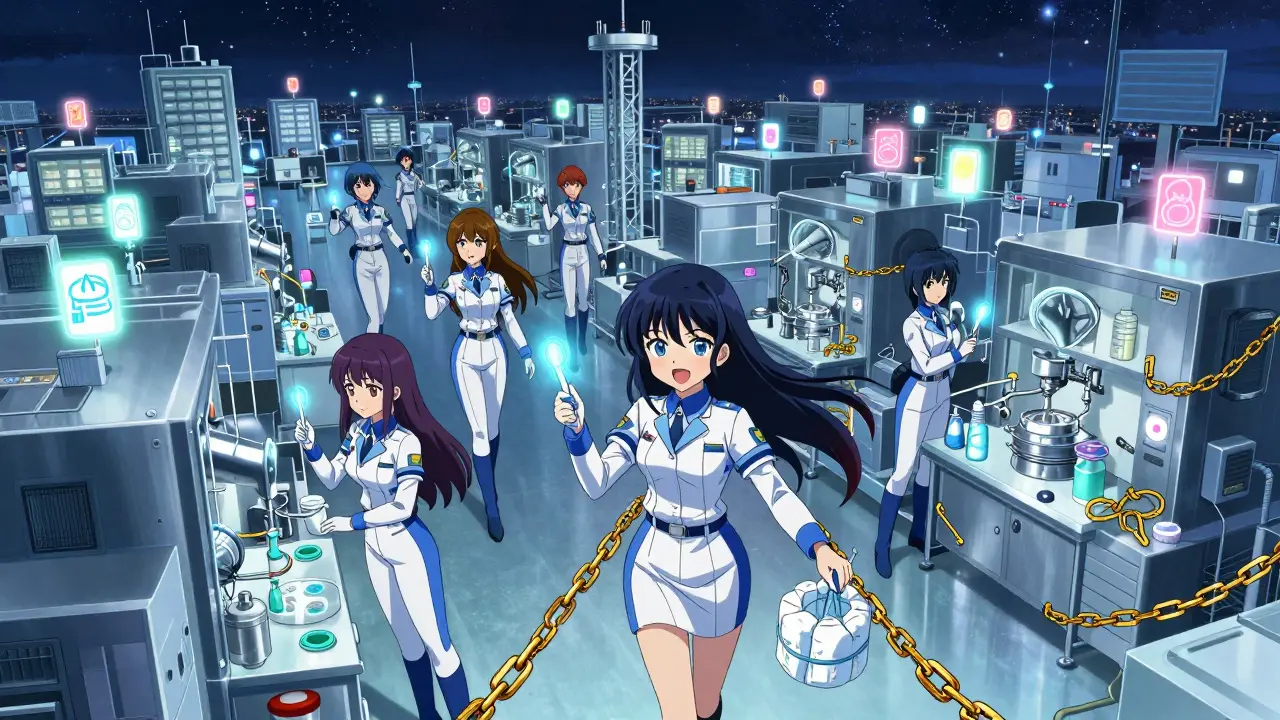
The FDA doesn’t just review paperwork. It inspects the factories where drugs are made. Every generic manufacturer-whether in the U.S. or overseas-must follow Current Good Manufacturing Practices, or cGMP. These aren’t suggestions. They’re legal requirements. cGMP covers every step: how raw materials are stored, how equipment is cleaned, how batches are tested, and how records are kept. For example:- Raw materials must be tested for purity before being used.
- Every step in production-mixing, compressing, coating-must follow written procedures with real-time monitoring.
- Finished pills are tested for strength, dissolution rate, and contamination.
Inspections: Domestic and Global
The FDA doesn’t wait for complaints to act. It sends inspectors to factories worldwide. In 2021, the agency conducted 1,082 inspections of generic drug facilities-74% of them overseas. By 2025, that number is expected to hit 1,500 per year thanks to funding from GDUFA III, the latest version of the Generic Drug User Fee Amendments. Before a generic drug is approved, the FDA often visits the manufacturing site. If inspectors find serious problems-like dirty equipment, falsified records, or unvalidated testing methods-the application gets a “refuse to receive” notice. No review. No approval. No second chance. Even after approval, inspections continue. The FDA aims to inspect every facility at least once every two years. Foreign plants are harder to reach, so the agency uses third-party auditors and shares data with regulators in Europe, Canada, and India. If a facility fails an inspection, the FDA can block imports or demand corrective actions before allowing shipments.Post-Market Surveillance: Watching for Problems After Approval
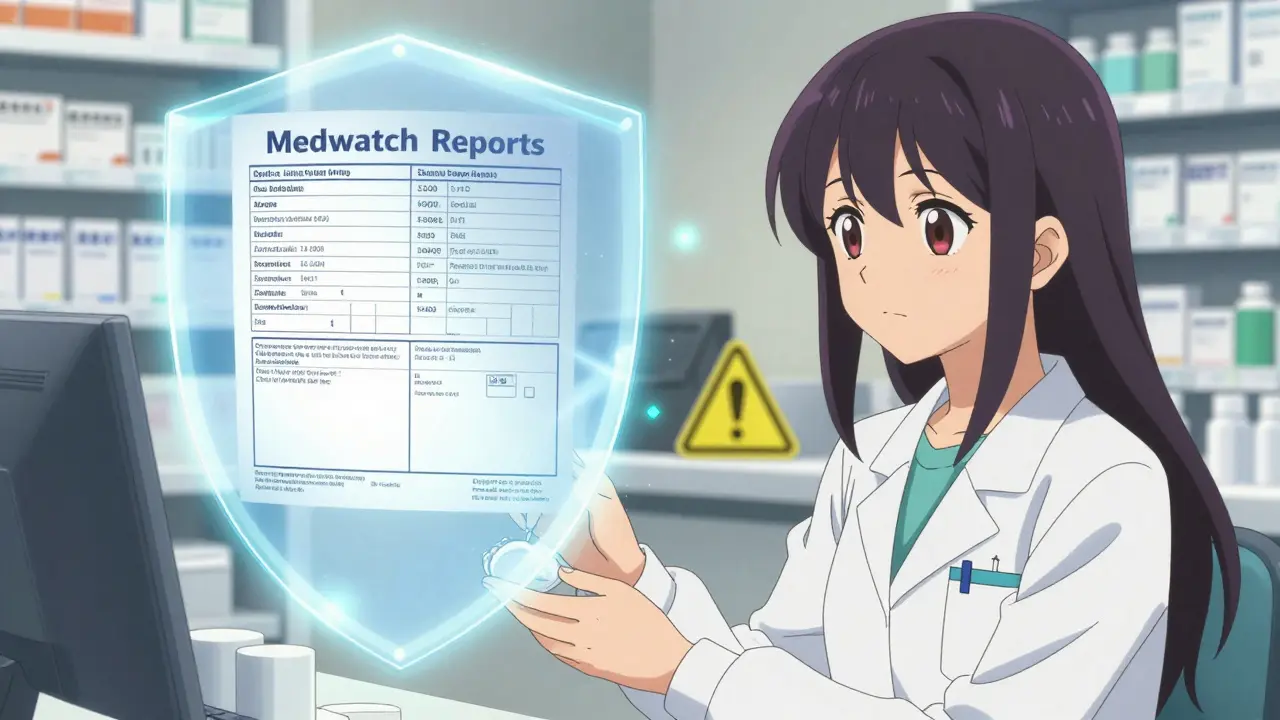
The FDA doesn’t stop monitoring once a drug is on the shelf. It tracks real-world use through MedWatch, a system where doctors, pharmacists, and patients report side effects. About 1.3 million reports come in each year. The Division of Clinical Safety and Surveillance digs into those reports. If a pattern emerges-say, more patients taking a specific generic version report dizziness or nausea-the FDA investigates. It compares the data to the brand-name version. If the generic is causing more issues, it could mean a problem with the formulation, the inactive ingredients, or the manufacturing process. When problems are confirmed, the FDA can take action:- Require a label update to warn about risks
- Issue a “Dear Healthcare Provider” letter
- Order a voluntary recall
Why This System Works-And Where It Still Struggles
The FDA’s approach has saved U.S. healthcare $313 billion a year. Generic drugs make up 90% of prescriptions but only 23% of drug spending. That’s because the system is built on science, not speed. But challenges remain. Some foreign manufacturers still cut corners. The FDA can’t be everywhere at once. And complex drugs-like inhalers, injectables, or topical creams-are harder to copy. A small difference in particle size or viscosity can change how the drug works. That’s why the FDA launched the Complex Generic Drug Products Initiative in 2018. It’s developing new testing methods and guidance for these tricky products. Today, the agency has published detailed bioequivalence recommendations for over 2,800 drugs-up 40% since 2018. The bottom line? Generic drugs are not “cheap copies.” They’re rigorously tested, inspected, and monitored. The FDA treats them with the same scrutiny as brand-name drugs. The difference isn’t quality-it’s cost.What Patients and Providers Should Know
If you’re switching from a brand to a generic, don’t worry. The FDA requires generics to match the original in dose, strength, safety, quality, and how they work in your body. If you notice a change in how you feel-like new side effects or reduced effectiveness-talk to your doctor. It’s rare, but it can happen. You can also check the FDA’s website for drug safety alerts or recall notices. And if you experience an adverse reaction, report it to MedWatch. Your report could help catch a problem before it affects others. The system isn’t perfect. But it’s one of the most thorough drug safety networks in the world. And it’s getting better-with more inspections, faster reviews, and smarter data tools.Are generic drugs as safe as brand-name drugs?
Yes. The FDA requires generic drugs to have the same active ingredient, strength, dosage form, and route of administration as the brand-name version. They must also prove bioequivalence-meaning they deliver the same amount of medicine into your bloodstream at the same rate. The FDA reviews manufacturing practices, lab testing, and real-world safety data to ensure they’re just as safe.
How does the FDA check if a generic drug is made properly?
The FDA inspects manufacturing facilities before approving a drug and continues inspecting them after approval. Inspectors look for compliance with Current Good Manufacturing Practices (cGMP), including how raw materials are handled, whether equipment is clean, and if testing methods are accurate. Foreign facilities are inspected too-often using shared data with international regulators. Facilities with past violations get priority inspections.
What happens if a generic drug causes side effects?
The FDA monitors reports of side effects through MedWatch, receiving about 1.3 million reports annually. If a pattern emerges-like more patients reporting issues with a specific generic-the agency investigates. It compares the data to the brand-name version. If the generic is linked to new or worse side effects, the FDA can update the label, issue a safety alert, or order a recall.
Why do some people say generics don’t work as well?
In rare cases, differences in inactive ingredients-like fillers or coatings-can affect how quickly a drug dissolves in the body. The FDA requires bioequivalence testing to catch this, but some patients may be more sensitive. If you feel a difference after switching, talk to your doctor. It doesn’t mean the drug is unsafe, but your body might react differently. Switching back or trying another generic version can help.
How long does it take for the FDA to approve a generic drug?
Before 2012, it took about 30 months on average. Thanks to the Generic Drug User Fee Amendments (GDUFA), the FDA now reviews standard ANDAs within 10 months for 95% of applications. Complex drugs or those with manufacturing issues take longer. The goal is to approve safe, effective generics faster without cutting corners.
Can I trust generics made overseas?
Yes-if the FDA has approved them. Over 80% of generic drug ingredients come from outside the U.S., mostly from India and China. The FDA inspects these facilities using the same standards as U.S. plants. In 2021, 74% of foreign inspections met FDA performance goals. The agency is increasing foreign inspections and using data-sharing agreements to improve oversight. If a foreign plant fails inspection, the FDA blocks imports until problems are fixed.

Sue Stone
January 23, 2026 AT 12:15So basically, the FDA is the only thing standing between me and a pill that does nothing or makes me sick. Wild that we trust this system so much.
Oladeji Omobolaji
January 24, 2026 AT 22:18I work in a pharmacy in Lagos and we get generics from all over. People here don’t have a choice - but if the FDA says it’s good, I trust it. Same pills, cheaper price. Win-win.
Anna Pryde-Smith
January 26, 2026 AT 03:53Let’s be real - the FDA is just a glorified paper pusher with a fancy title. They inspect factories once every two years? Meanwhile, factories in India are cooking up pills in basements with no AC and rats running through the mixing tanks. You think they’re testing dissolution rates? Nah. They’re testing how fast they can ship it out before the next inspection.
And don’t get me started on ‘bioequivalence.’ That’s just a fancy word for ‘close enough.’ My cousin took a generic blood thinner and ended up in the ER. The label said ‘same as brand.’ It wasn’t. The FDA didn’t catch it until three people died. That’s not oversight - that’s negligence dressed up in a lab coat.
And now they want to inspect 1,500 facilities a year? Good luck with that. Half of those inspectors don’t speak the language. Half the factories lie about their records. And the rest? They just bribe their way through. This whole system is a house of cards built on trust and wishful thinking.
Kerry Evans
January 28, 2026 AT 00:46Anna, your emotional outburst is understandable, but it’s not evidence. The FDA’s rejection rate for ANDAs due to cGMP violations is over 20% annually. That’s not negligence - that’s enforcement. The 2020 valsartan recall? The same contaminant was found in both brand and generic versions, and the FDA acted on both. That’s not a flaw in the system - it’s proof it works.
Also, the claim that foreign facilities ‘lie about records’ is unsubstantiated. The FDA uses third-party auditors, data-sharing agreements with EMA and WHO, and AI-driven risk modeling to flag anomalies. In 2021, 74% of foreign inspections met performance goals. That’s higher than many U.S. hospitals.
And yes - bioequivalence is statistically rigorous. The 90–110% window is based on pharmacokinetic modeling from thousands of trials. If a drug falls outside that, it’s rejected. Period. No exceptions.
Emotion is valid. But policy isn’t made by anecdotes. It’s made by data. And the data says generics are safe.
Dawson Taylor
January 29, 2026 AT 04:37It’s fascinating how we’ve built a global system of trust around pills. We don’t know who made them, where they came from, or what their lab looked like - yet we swallow them without hesitation. The FDA doesn’t just regulate drugs - it regulates human faith.
That’s the real miracle here. Not the chemistry. Not the bioequivalence. The fact that millions of people, in dozens of countries, place their lives in the hands of a bureaucratic system they’ve never seen - and it mostly works.
Sallie Jane Barnes
January 30, 2026 AT 05:51My grandma takes 7 generics a day. She’s 84. No side effects. No hospital visits. She doesn’t know what an ANDA is, but she knows her pills work. And that’s all that matters.
Stop overcomplicating it. The system isn’t perfect, but it’s working for real people. Let’s not scare folks into thinking their meds are poison just because we like to argue online.
Laura Rice
February 1, 2026 AT 03:08ok but like… what if your generic has a different filler? like i switched to a generic lisinopril and i swear i felt like i was being slowly poisoned for 3 weeks. headaches, nausea, felt like i had the flu. switched back to brand - poof. gone. i didn’t even think to report it. should i have? like… is that even a thing they care about?
Janet King
February 2, 2026 AT 05:01Yes, report it. MedWatch exists for exactly that reason. Differences in inactive ingredients - like lactose, dyes, or coatings - can affect how fast a drug dissolves. The FDA requires bioequivalence, but individual sensitivity varies. Your experience is valid and valuable. Reporting helps them identify patterns before others get sick.
Kerry Moore
February 2, 2026 AT 15:17Thank you for that clear, factual response. It’s rare to see calm, evidence-based communication in these threads. Laura’s experience isn’t an outlier - it’s data. And data, when aggregated, improves the system. The FDA’s Complex Generic Drug Initiative is actively studying exactly these cases. Your report could be the one that leads to a reform in filler standards.
Let’s not dismiss individual experiences as anecdotes. They’re the seeds of scientific progress.