
More than 1 in 4 pregnant women take herbal supplements. They reach for ginger tea for morning sickness, raspberry leaf to prepare for labor, or chamomile to sleep better-often believing these are safer than pills because they’re "natural." But "natural" doesn’t mean safe, especially when you’re pregnant. The truth is, we simply don’t know enough about most herbal products during pregnancy. And that’s not just a gap in research-it’s a risk.
What Herbal Supplements Are Actually Used During Pregnancy
Ginger is the most common. Around 28% of pregnant women in one large Spanish study used it, mostly in the first trimester to fight nausea. That’s not surprising-studies show it works. Taking up to 1,000 mg per day of ginger is linked to less vomiting and nausea, with no clear signs of harm to the baby. It’s even recommended by the American Academy of Family Physicians as a first-line option for nausea, ahead of some prescription meds.
Chamomile comes next. Used for relaxation and sleep, it’s found in teas and capsules. But here’s the problem: some research links it to higher risks of preterm birth, low birth weight, and even issues with fetal heart development. The same study that found chamomile popular also showed that 9% of pregnant women took it, even though evidence is mixed and contradictory.
Raspberry leaf is another big one-especially in the third trimester. About 78% of women who used it started taking it then, believing it would "tone the uterus" and make labor easier. But the American Academy of Family Physicians says this use is "likely unsafe." There’s evidence it might increase the chance of cesarean delivery when used to try to induce labor. And because there’s no standard dose, you could be taking twice as much as someone else with the same product.
Cranberry supplements are taken to prevent urinary tract infections (UTIs), which are common in pregnancy. They might help a little, but they’re not as reliable as antibiotics like nitrofurantoin. Worse, some women report spotting in the second or third trimester after taking cranberry supplements. That’s not normal, and it’s not well studied.
And then there are herbs like rosemary, pennyroyal, and blue cohosh. These aren’t just risky-they’re dangerous. Rosemary, when taken in medicinal doses, can trigger uterine contractions. Pennyroyal and blue cohosh are outright toxic during pregnancy and have been linked to miscarriage and fetal death. Yet they’re still sold online as "natural remedies."
Why We Don’t Know What’s Safe
The biggest reason we’re flying blind? Pregnant women are almost never included in clinical trials. Drug companies avoid it-not because they’re careless, but because of liability. If something goes wrong, the legal and ethical fallout is huge. So, we’re left with small studies, anecdotal reports, and centuries-old traditions.
The FDA doesn’t regulate herbal supplements like prescription drugs. That means a bottle labeled "1,000 mg of raspberry leaf" might actually contain 500 mg-or 2,000 mg. Or it might have unlisted ingredients like heavy metals, pesticides, or even other herbs you didn’t ask for. One FDA inspection found that 20% to 60% of herbal products had incorrect labeling or contamination.
Even the names are confusing. "Raspberry leaf" could mean Rubus idaeus, or it could be a blend with other plants. There’s no standardization. Two brands might call it the same thing, but one could be strong enough to trigger contractions, and the other might be harmless.
And here’s the kicker: most studies on herbal supplements in pregnancy are observational. They watch what happens, but they can’t prove cause and effect. So when a woman takes chamomile and her baby is born early, we can’t say for sure the herb caused it. But we also can’t say it didn’t.
Herbal vs. Conventional: The Real Trade-Offs
People often choose herbs because they think they’re safer than drugs. But that’s not always true.
Ginger is one of the few herbs that actually holds up. It’s as effective as some anti-nausea medications and has fewer side effects. That’s why doctors recommend it.
But compare that to cranberry for UTIs. Antibiotics like nitrofurantoin have been studied for decades in pregnancy. We know the risks, we know the dosing, and we know how to monitor for side effects. Cranberry? It might help a little, but it’s not reliable. And if you’re relying on it to avoid antibiotics, you could end up with a kidney infection-something far more dangerous than the antibiotic itself.
Raspberry leaf is another example. Traditional birth workers swear by it. But modern studies show no clear benefit in reducing labor time or complications. What they do show? A higher chance of needing a C-section if used to try to start labor. That’s not a small risk. It’s a major medical outcome.
The real difference isn’t "natural vs. synthetic." It’s "known vs. unknown." Prescription drugs have safety labels for pregnancy-categories like "Category B" or "Category C." Herbal supplements? They have no such labels. No warnings. No dosing guidelines. Just a label that says "for wellness."

Who’s Taking These Supplements-and Why
It’s not just about health. Culture, family, and social media drive a lot of this.
In Catalonia, nearly half of pregnant women use herbal products. In Korea, it’s 58%. In Scandinavia, it’s only 22%. That’s not because one group is healthier-it’s because traditional medicine is woven into daily life in some cultures.
And then there’s the internet. In one Reddit thread about herbal teas in pregnancy, 78% of the 142 commenters said they were unsure what was safe. Yet 63% of them were still using at least one herbal product. Most said they got advice from family (38%), social media (29%), or Google (24%). Only 14% talked to their doctor first.
That’s the problem. Women aren’t being warned. They’re being encouraged-with good intentions, but without facts. A grandmother says, "My sister drank raspberry leaf tea and had an easy birth." A TikTok video shows a woman sipping chamomile tea while glowing and calm. No mention of the risks. No mention of the lack of proof.
What Doctors Really Say
The American College of Obstetricians and Gynecologists (ACOG) is clear: "Don’t take any herbal products without talking to your provider first." Cleveland Clinic says it even more bluntly: "People who are pregnant are encouraged to avoid most herbal supplements." The FDA warns that "natural herbs and vitamin supplements do not go through the same scrutiny" as prescription drugs. And they’re right. A product can be sold in the U.S. as a supplement even if no one has tested it for safety in pregnancy.
Some providers are starting to ask. A 2023 study showed that when doctors directly asked pregnant women about herbal use, more women admitted to using them. Before that, many didn’t think it was important to mention. But if your doctor doesn’t ask, you might not bring it up. And that’s dangerous.
Herbal supplements can interact with prenatal vitamins, iron pills, or even blood pressure meds. Ginger can thin your blood. Chamomile might interfere with sedatives. Raspberry leaf could amplify contractions if you’re on Pitocin. These aren’t hypothetical risks. They’re documented.
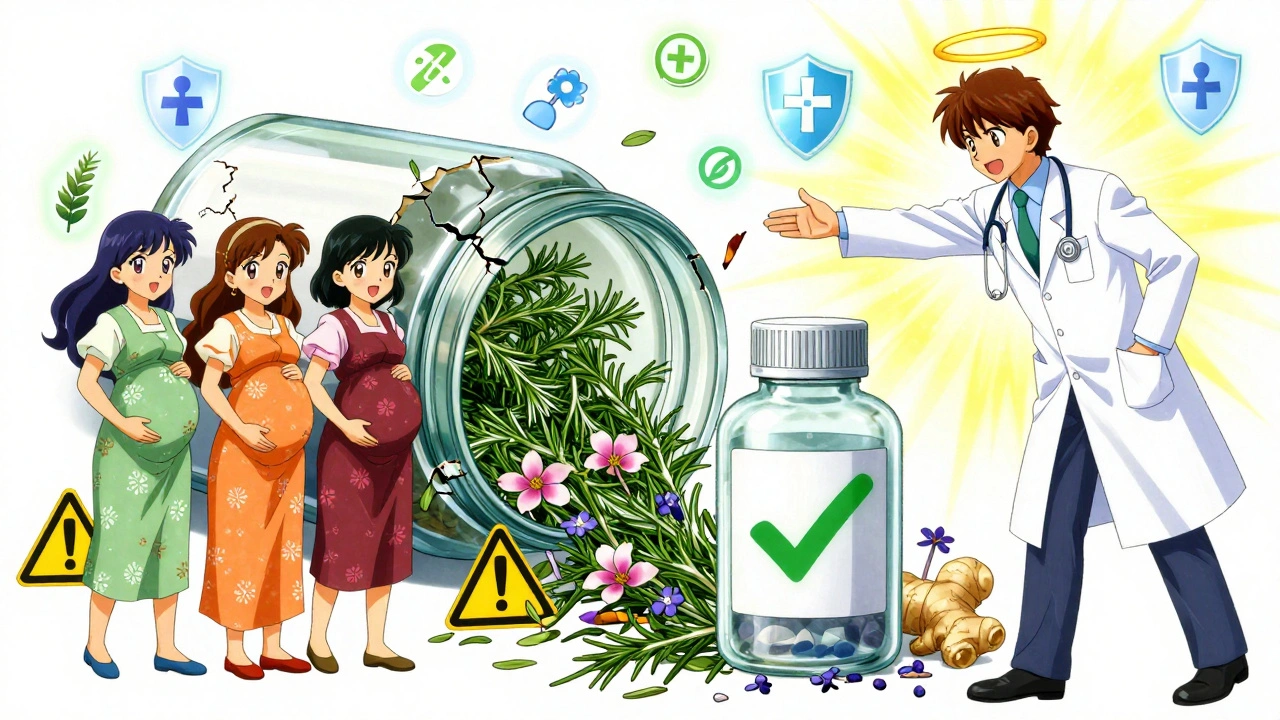
What You Should Do
If you’re pregnant and thinking about taking an herbal supplement, here’s what to do:
- Stop assuming it’s safe. Just because it’s a plant doesn’t mean it’s harmless. Plants have powerful chemicals-some of them designed to protect the plant from animals. That includes compounds that can affect your uterus, hormones, or your baby’s development.
- Talk to your provider before you take anything. Not after. Not "just this once." Before. Bring the bottle. Show them the label. Ask: "Is this safe for me right now?"
- Stick with ginger for nausea. It’s the only herb with strong, consistent safety data for pregnancy. Stick to 250-500 mg up to four times a day. Don’t go over 1,000 mg.
- Avoid raspberry leaf until after 36 weeks. Even then, don’t use it to try to induce labor. There’s no proof it helps, and there’s proof it can hurt.
- Don’t use rosemary, pennyroyal, blue cohosh, or black cohosh. These are known to be dangerous. Avoid them completely.
- Check the source. Buy from reputable brands that list exact amounts of ingredients and third-party testing. Look for USP or NSF certification on the label.
The Bigger Picture
There’s a $85 billion global market for herbal supplements. Pregnancy-specific products are a growing slice of that pie. Companies are marketing to expectant mothers with images of calm, glowing women drinking herbal teas. They’re not showing the risks. They’re not showing the lack of data.
The National Institutes of Health just launched a $12.7 million study to fix this. But it’ll take years to get answers. In the meantime, millions of women are making decisions with incomplete information.
The truth is, we need better science. But we also need better communication. Pregnant women deserve to know what’s safe-not what’s trendy, not what’s traditional, not what’s on a TikTok video. They deserve facts.
Until then, the safest choice is simple: if you’re not sure, don’t take it. And if you’re already taking something, talk to your doctor. No judgment. No shame. Just information.

Emma Sbarge
December 13, 2025 AT 13:17Let’s be real-natural doesn’t mean safe. My sister took chamomile tea because her mom said it helped her sleep, and she went into preterm labor at 34 weeks. No one warned her. No one even asked. We’re not talking about herbal tea from a garden. We’re talking about unregulated chemicals that could be poisoning a fetus and no one’s checking the labels.
Richard Ayres
December 14, 2025 AT 19:11This is one of the clearest, most balanced takes I’ve read on this topic. The distinction between 'known vs. unknown' is critical. Ginger has data. Raspberry leaf has tradition. But tradition isn’t evidence. And in pregnancy, evidence is the only thing that matters when lives are on the line. We need more science, not more anecdotes.
Michael Gardner
December 16, 2025 AT 18:15So what, we just avoid all plants now? Next you’ll say carrots are dangerous because they have beta-carotene. This whole thing is fearmongering dressed up as science. If you’re worried about supplements, why not just eat food like a normal person?
Willie Onst
December 18, 2025 AT 12:38I grew up in Nigeria where every grandma has a tea for every ailment. My mom drank ginger and hibiscus tea during all three pregnancies. All three kids are healthy, thriving adults. I’m not saying every herb is safe, but dismissing centuries of cultural wisdom just because it’s not in a double-blind trial feels… arrogant. Maybe the problem isn’t the herbs-it’s that we stopped listening to lived experience.
Also, I bought my raspberry leaf tea from a Nigerian herbalist who hand-picked it. The label said 500mg. I doubt it had heavy metals. Maybe the real issue is corporate greed, not tradition.
Jennifer Taylor
December 20, 2025 AT 04:49THEY KNOW. THEY KNOW AND THEY DON’T TELL YOU. The FDA, Big Pharma, the OB-GYNs-they’re all in on it. Why? Because if pregnant women started using safe, natural herbs, they wouldn’t need C-sections, epidurals, Pitocin, or $12,000 hospital bills. So they scare you with ‘preterm birth’ and ‘fetal heart issues’ to keep you hooked on their drugs. I found a leaked internal memo from a supplement company saying they deliberately under-label doses because ‘pregnant women won’t read it anyway.’ I’m not crazy. Look up the FDA’s 2021 inspection reports. 60% of brands are contaminated. They’re letting poison into your body and calling it ‘wellness.’
Shelby Ume
December 20, 2025 AT 15:05To the person who said ‘just eat food’-I hear you. But sometimes, nausea is so severe you can’t keep rice down. Sometimes, UTIs become pyelonephritis if untreated. Sometimes, insomnia leads to preeclampsia risk. We aren’t choosing herbs because we’re lazy-we’re choosing them because conventional options failed us. And yes, we should talk to our doctors. But most doctors don’t know enough about herbs to give good advice. They say ‘avoid everything’ because they’re afraid of liability, not because they’re informed. We need providers who are educated on integrative options-not just scared of lawsuits.
Jade Hovet
December 20, 2025 AT 21:17OMG YES THANK YOU FOR THIS POST!!! 😭 I took ginger for nausea and felt like a hero, then my friend told me raspberry leaf was magic for labor so I bought it… then I panicked and stopped. I had NO IDEA it could cause a c-section. I’m so glad I read this before 36 weeks. I’m gonna show my OB this tomorrow. Also, I bought USP-certified cranberry now, no more random Amazon stuff 💪🙏
nina nakamura
December 21, 2025 AT 15:13