
Imagine taking a pill every day for your blood pressure. One day, you pick it up from the pharmacy and it looks completely different-smaller, pink instead of white, round instead of oval. You stop taking it. Not because you feel better, but because you’re sure it’s not the same medicine. This happens more often than you think. And it’s not because patients are careless. It’s because the system isn’t designed for people with low health literacy.
Why Generic Medications Confuse People
Generic drugs are just as effective as brand-name drugs. They contain the same active ingredients, work the same way, and are held to the same safety standards. But they don’t look the same. And that’s the problem. Patients don’t know that. A 2016 study found that 42% of people didn’t realize generics are therapeutically identical to brand-name drugs. When the color, shape, or size changes-something that happens every time a pharmacy switches manufacturers-many patients think they’ve been given the wrong medicine. Some even believe generics are weaker or unsafe. This isn’t just a misunderstanding. It’s a safety risk. A 2021 study in the Journal of the American Geriatrics Society found that over half of older adults taking heart medications threw away pills that looked different. One man with diabetes didn’t take his metformin for three days after his pills changed shape. He ended up in the ER with dangerously high blood sugar. The issue is worse for people with low health literacy. The National Network of Libraries of Medicine estimates 80 million American adults struggle to understand basic health information. For them, pill appearance isn’t just a detail-it’s the main way they identify their medicine. When that changes, trust breaks down.Brand vs. Generic: The Perception Gap
Brand-name drugs come with ads, logos, and familiar packaging. People see them on TV. They remember the name. Generics? No marketing. No recognition. Just a plain label and a different-looking pill. A 2018 study showed that 68% of patients worried about how well generics worked, compared to just 22% for brand-name drugs. Even though science says they’re the same, perception tells a different story. This gap is biggest among older adults, people with less education, and those managing multiple medications. Medicare beneficiaries with low literacy are over three times more likely to refuse a generic substitution, according to a 2020 Kaiser Family Foundation report. That’s not stubbornness. It’s confusion. When you’re juggling five or six pills a day, and one looks different every time you refill, it’s easy to panic. The Institute for Safe Medication Practices recorded over 1,200 medication errors between 2015 and 2020 caused by confusion between different generic versions of the same drug. That’s 17% of all generic-related errors. And it’s preventable.What Patients Need to Know
There are six key things every patient should understand about their medicines, especially generics:- Name of medicine-What’s the brand name? What’s the generic name? Are they the same thing?
- What it’s for-Why are you taking this? High blood pressure? Diabetes? Depression?
- How to take it-Morning or night? With food? Can you crush it?
- How to store it-Fridge? Cabinet? Away from light?
- Side effects-What’s normal? What’s dangerous?
- When to call your doctor-If you feel worse, if you miss a dose, if the pill looks different.

What’s Being Done to Fix It
Some solutions are already working. In Australia, a medication color-coding system was introduced. All blood pressure meds are blue. All diabetes meds are green. All cholesterol meds are yellow. Since 2020, errors from visual confusion dropped by 33%. Now, the FDA is considering a similar approach. The ‘Ask Me 3’ program trains doctors and pharmacists to ask three simple questions: What is my main problem? What do I need to do? Why is it important? Hospitals using this program saw a 31% drop in generic-related medication errors. The Brown Bag Medication Review asks patients to bring all their pills-bottles, blister packs, even the ones in the drawer-to their appointment. Pharmacists sort them out, check for duplicates, and explain what each one is. Johns Hopkins found this reduced medication mistakes by 44%. Digital tools are helping too. The Medisafe app lets users take a picture of their pill. It recognizes the shape, color, and imprint, then tells them the name, purpose, and dosage. In a 2022 trial, it improved understanding of generics by 37%. And in 2023, the FDA approved $4.7 million for health literacy projects focused on generics. That’s a 200% increase since 2019.The Bigger Picture: Health Literacy Is a System Problem
This isn’t about teaching patients to read better. It’s about making information easier to understand. Dr. Ruth Parker, a leading expert in health literacy, calls the changing appearance of generics a “systemic failure.” She’s right. If a patient can’t recognize their medicine, the system has failed them-not the patient. The World Health Organization says standardized packaging for generics should be a global priority. The European Union already requires consistent shapes and colors for certain drugs. In pilot programs in Germany and France, medication errors dropped by 19%. The American Pharmacists Association now recommends pharmacists do a quick health literacy check every time they switch a patient to a generic. Thirty-eight U.S. states have introduced bills to make this standard practice. And AI is stepping in. A June 2023 study in the New England Journal of Medicine tested an AI tool that showed patients a photo of their pill and explained it in plain language. For people with low literacy, understanding improved by 63%.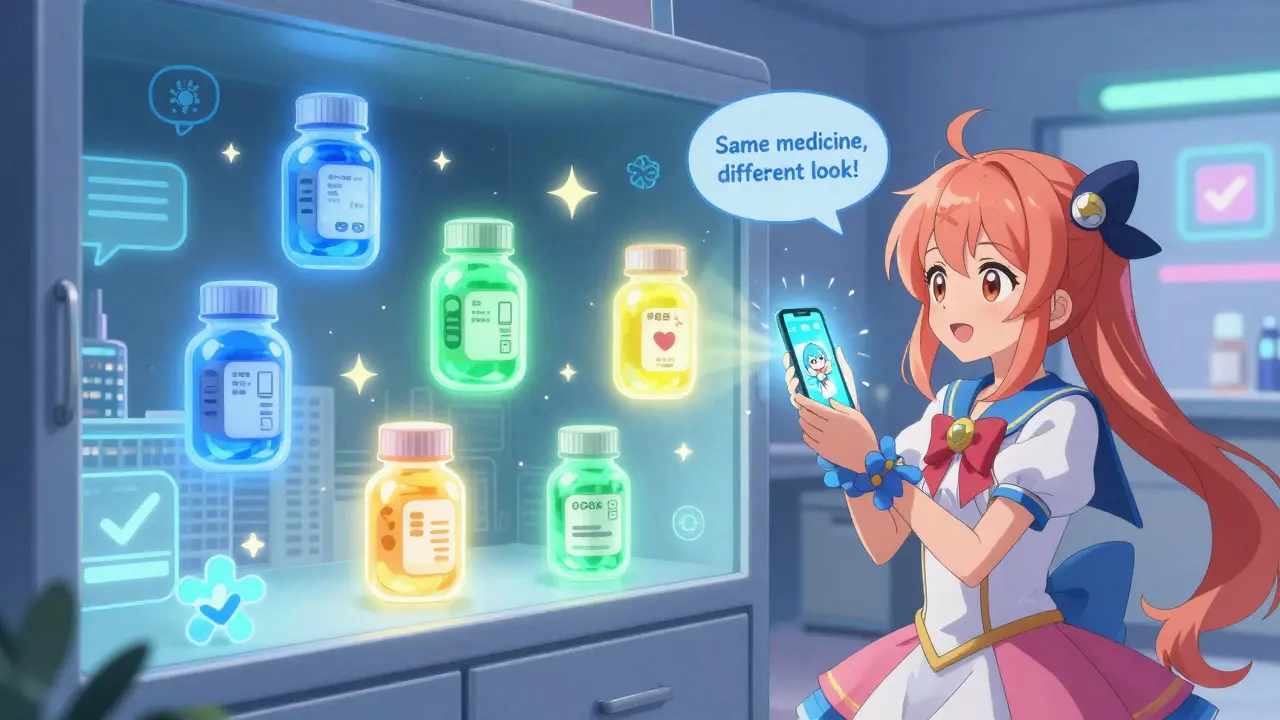
What You Can Do Right Now
If you or someone you care about takes generics, here’s what to do:- Always ask: Is this the same medicine, just a different look?
- Take a photo of your pills when you get them. Save it on your phone.
- Keep a list of all your meds: name, dose, why you take it, and what it looks like.
- Bring all your pills to every doctor visit-even the ones you haven’t taken in months.
- If something looks different, don’t guess. Call your pharmacist. Ask: Is this still my medicine?
Why This Matters More Than You Think
Generic drugs save the U.S. healthcare system over $300 billion a year. They make life-saving medicines affordable. But if people stop taking them because they don’t recognize them, those savings vanish. Patients who don’t take their meds as prescribed are more likely to be hospitalized, end up in the ER, or die prematurely. The cost isn’t just financial-it’s human. The goal isn’t to stop generics. It’s to make sure everyone understands them. Because when patients know what they’re taking, they take it. And when they take it, they stay healthy.Are generic medications as effective as brand-name drugs?
Yes. Generic medications contain the same active ingredients, work the same way, and are held to the same FDA safety and effectiveness standards as brand-name drugs. The only differences are in color, shape, size, and inactive ingredients-none of which affect how well the medicine works.
Why do generic pills look different each time I refill them?
Different manufacturers make the same generic drug, and each one uses its own design for color, shape, and markings. Pharmacies often switch between manufacturers to get the best price, which is why your pill may look different-even though it’s the same medicine.
What should I do if my generic pill looks different?
Don’t stop taking it. Don’t assume it’s wrong. Call your pharmacist and ask: ‘Is this still the same medication?’ They can confirm the name, dosage, and that it’s safe to take. Keep a photo of your pills on your phone so you can compare them easily.
How can I avoid confusion with multiple medications?
Use a pill organizer labeled with days and times. Take a photo of each pill when you first get it. Keep a written list with the drug name (brand and generic), purpose, and appearance. Bring all your meds to every doctor visit in a ‘brown bag’ so your provider can check everything.
Can I ask my pharmacist to always give me the same generic brand?
Yes. You can ask your pharmacist to fill your prescription with the same manufacturer each time. Some pharmacies can do this, though it may take longer or cost slightly more. If you’re confused or anxious about changes, this is a reasonable request.
Is there a tool that can help me identify my pills?
Yes. Apps like Medisafe and MyTherapy let you take a picture of your pill and will identify it by shape, color, and imprint. Some also track doses and send reminders. These tools are especially helpful for people with low health literacy or those taking many medications.
Curtis Younker
January 25, 2026 AT 03:08Man, I used to be one of those people who’d toss out a pill just because it looked different. I thought generics were like knockoff sneakers-same name, but weak sauce. Then my grandma had a stroke because she stopped her blood pressure med after the color changed. I didn’t know it could kill someone just because of a damn pill’s shade of pink. Now I take a pic of every new script, keep a note on my phone, and I even show my pharmacist the pic before I leave. It’s not rocket science, but the system sure acts like it is. Why can’t they just make all blood pressure pills blue like they do in Australia? That’s not hard. We’re not asking for gold-plated pills, just consistency. My grandma’s alive because I learned this the hard way. Don’t wait for a hospital visit to figure it out. Save yourself the trauma.
Shawn Raja
January 25, 2026 AT 15:26So let me get this straight-we’ve got a $300 billion industry built on pills that look like they were designed by a 5-year-old with a crayon, and the solution is… more apps? More color codes? More ‘Ask Me 3’ posters in waiting rooms? Meanwhile, the real problem is that we treat patients like dumb terminals who need to be ‘educated’ instead of designing systems that don’t require education to use. We don’t need to teach people to read labels-we need to stop making labels that require a PhD to decode. Why does a pill for diabetes have to look like a tiny alien artifact? Why can’t the system just… be intuitive? The fact that we’re still having this conversation in 2025 is a national embarrassment. And no, ‘Medisafe’ isn’t the answer. The answer is dignity. Give people pills that don’t make them feel like criminals for not being pharmacists.
Ryan W
January 26, 2026 AT 01:45Let’s be clear: this isn’t a health literacy issue-it’s a cultural decay issue. People can’t identify pills because they’ve been raised on TikTok and can’t read past the third sentence. The FDA spends millions on apps and color codes, but nobody’s holding parents accountable for teaching basic responsibility. If your kid can’t tell the difference between a blue pill and a pink one, that’s not a systemic failure-that’s a parenting failure. Also, ‘brown bag reviews’? That’s a band-aid. What we need is mandatory medication literacy in high school. No diploma without knowing what your meds do. And stop calling it ‘health literacy’-it’s just basic cognitive function. If you can’t handle a pill bottle, maybe you shouldn’t be managing your own meds. End of story.
Allie Lehto
January 26, 2026 AT 21:30OMG I’m crying rn 😭 I used to be so scared of my meds changing colors... I thought I was going crazy. I even Googled ‘is this poison?’ once. My mom said I was being dramatic but then she started doing the brown bag thing with me and now I feel so much safer. I made a little notebook with pictures of my pills and what they’re for. I even colored them with crayons so I don’t forget. It’s dumb but it works. 🖍️💊 I just wish pharmacists would smile more when I ask dumb questions. You’re not dumb for needing help. 💙
Henry Jenkins
January 26, 2026 AT 22:09I’ve been working in community health for over 15 years, and this issue keeps coming up-not because people are ignorant, but because the system is designed to be confusing. You think it’s just about pills? No. It’s about trust. When you’ve been told your meds are the same but they look different every time, you start to distrust everything-your doctor, your pharmacy, even your own memory. That’s why the ‘brown bag’ method works so well. It’s not about the pills-it’s about restoring agency. When you hold your own meds in your hands and someone says, ‘Yes, this is still your medicine,’ it’s a tiny act of validation. That’s what we’re missing. The color-coding in Australia? Brilliant. The AI photo-recognizer? Brilliant. But the real win is when a pharmacist pauses, looks you in the eye, and says, ‘I know this looks weird, but here’s why it’s safe.’ That’s the kind of care we should be standardizing, not just the apps.
Dan Nichols
January 28, 2026 AT 21:37Stop pretending this is a big deal. People are just lazy. If you can’t remember what your pill looks like, you’re not sick-you’re irresponsible. I take 7 meds a day and I know exactly what each one looks like because I’m not a child. Why should the system bend for people who can’t be bothered to read a label? The FDA’s spending millions on apps and color codes? That’s taxpayer money wasted. The real problem is entitlement. People want everything handed to them on a silver platter. If you can’t handle a pill, maybe you shouldn’t be on so many. Simple.
Renia Pyles
January 30, 2026 AT 13:44Oh please. You’re all acting like this is some noble cause. It’s not. It’s corporate greed wrapped in a pink pill. Pharmacies switch generics because they get paid more for the cheapest version-not because it’s better. And now they want us to believe color codes and apps are the solution? Nah. They just want you to stop asking questions. If you really cared, you’d make the same manufacturer supply every generic. But that’d cut profits. So instead, you give people apps. You give them ‘Ask Me 3’ pamphlets. You give them photos. You give them everything except the truth: that the system is rigged to profit off your confusion. Don’t be fooled. This isn’t about safety. It’s about money. And you’re all just polishing the cage while they keep feeding you the same poisoned food.
Rakesh Kakkad
January 30, 2026 AT 16:33Thank you for this thoughtful and comprehensive analysis. As a healthcare professional from India, I have witnessed similar challenges in rural clinics where patients often confuse generic formulations due to lack of visual consistency. The Australian color-coding model is indeed commendable, and I believe its implementation in low-resource settings could be transformative if adapted with local cultural context. In our pilot program in Kerala, we introduced pictorial labels alongside color coding, and adherence improved by 41% among elderly patients. The key is not technology alone, but human-centered design. We also train community health workers to use simple, non-technical language. A picture of a heart next to a blood pressure pill, for example, speaks louder than any label. This is not just a medical issue-it is a social justice imperative.