
Why Your Dialysis Access Matters More Than You Think
If you’re on hemodialysis, your access point isn’t just a tube or a needle site-it’s your lifeline. Every time you sit down for treatment, your blood flows through this connection to be cleaned. And how well that connection works determines how safe, comfortable, and long-lasting your dialysis journey will be.
There are three main types of dialysis access: arteriovenous (AV) fistulas, AV grafts, and central venous catheters. Each has its own pros, cons, and care needs. But here’s the truth most people don’t hear until it’s too late: AV fistulas are the gold standard for a reason. They last longer, cause fewer infections, and give you a better shot at staying out of the hospital.
What Is an AV Fistula-and Why Is It the Best Choice?
An AV fistula is made by surgically connecting an artery directly to a vein, usually in your forearm. This isn’t just a simple stitch job. It forces more blood to rush through the vein, making it thicker, stronger, and more visible over time. That’s what lets nurses stick needles in it safely, every few days, for years.
It takes 6 to 8 weeks to mature. That means you can’t use it right away. But once it’s ready, it can last decades. Some people have had the same fistula for 15, 20, even 25 years. And if you take care of it, you’ll rarely need surgery to fix it.
Why do doctors push fistulas so hard? Because the data doesn’t lie. People using fistulas have a 36% lower risk of dying each year compared to those using grafts, and more than 50% lower risk than those stuck with catheters. That’s not just a number-it’s more time with family, fewer hospital stays, and less fear of infection.
One patient in Sydney told me, “My fistula’s been working for seven years. I forget it’s even there until I feel the buzz when I touch it.” That buzz? That’s the thrill-the vibration that tells you blood is flowing the way it should. If it disappears, call your clinic. Right away.
When a Fistula Isn’t Possible: AV Grafts Explained
Not everyone has veins strong enough for a fistula. If your veins are too small, too scarred, or damaged from past IVs, your surgeon might suggest an AV graft instead.
A graft is a synthetic tube-usually made of PTFE, a tough plastic material-that connects your artery to your vein. It’s placed under the skin, often in the arm, and can be used in just 2 to 3 weeks. That’s faster than a fistula, which is why it’s used when you need access sooner.
But here’s the catch: grafts don’t last as long. About half of them will need some kind of intervention within the first year. That could mean a procedure to clear a clot, fix a narrowing, or replace the graft entirely. They’re also more likely to get infected than fistulas.
Patients with grafts often describe a pattern: “I had to go in for a clot removal every few months. It got tiring.” That’s common. Grafts clot more easily because the synthetic material doesn’t integrate with your body like your own vein does.
Still, a graft is far better than a long-term catheter. If your fistula failed or wasn’t possible, a graft gives you a durable, reliable option. Just know: you’ll need to be extra careful with it. Check for thrill daily. Watch for redness, swelling, or warmth. Report anything strange.
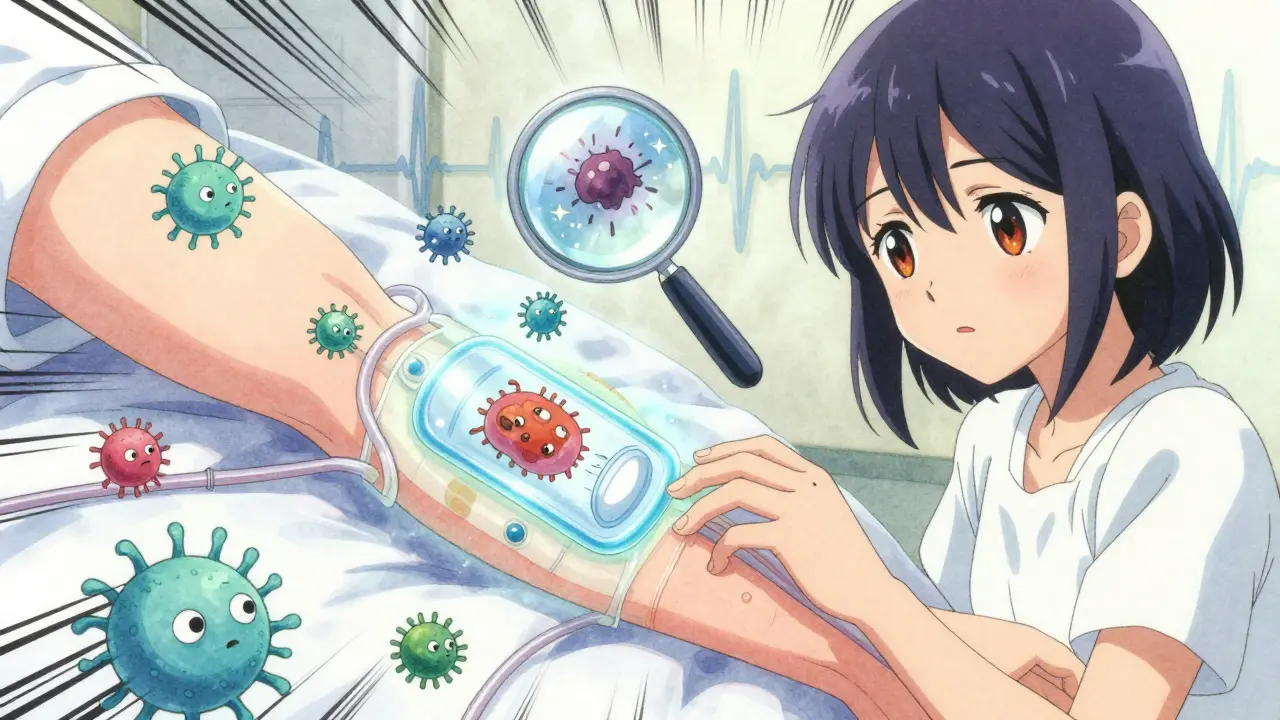
Catheters: The Temporary Fix That Sometimes Becomes Permanent
Catheters are soft tubes inserted into large veins-usually in your neck, chest, or groin. They’re the only option if you need dialysis right away. There’s no waiting. You can start treatment the same day.
But they’re the riskiest access type. Every time you shower, you have to cover it with plastic. You can’t swim. You can’t soak in a bath. Even a small splash can lead to a deadly bloodstream infection.
Studies show catheter users are more than twice as likely to die from an infection than fistula users. Each year, about 0.6 to 1.0 bloodstream infections happen for every 1,000 days a catheter is in place. That adds up fast. One infection can land you in ICU. Two might mean losing your access forever.
And yet, too many people stay on catheters long-term. Why? Sometimes it’s because their veins are too damaged. Sometimes it’s because they didn’t get referred for fistula surgery early enough. And sometimes, it’s because they didn’t know there were better options.
If you’re on a catheter, don’t accept it as permanent unless you’ve truly exhausted every other option. Ask your care team: “Can I have vein mapping? Is a fistula still possible?” Even if you’ve been on dialysis for months, it’s not too late to switch.
How to Care for Your Dialysis Access-Daily Steps That Save Lives
Care isn’t something you do once a week. It’s something you do every single day.
For Fistulas:
- Check for thrill every morning. Use your fingertips to feel for a gentle vibration. If it’s gone, call your dialysis center immediately.
- Keep the area clean. Wash with mild soap daily. Don’t scratch or pick at the skin.
- Don’t let anyone take your blood pressure or draw blood from that arm. Ever.
- Wear loose clothing. Tight sleeves can pinch the fistula.
- Don’t sleep on that arm.
For Grafts:
- Check thrill daily-same as a fistula.
- Watch for swelling, bulging, or discoloration. These can signal a clot or aneurysm.
- Keep the graft site dry after showering. Pat it gently.
- Report any pain, warmth, or redness right away.
For Catheters:
- Keep the dressing clean and dry at all times. Change it only as instructed by your nurse.
- Never touch the catheter ends unless you’ve washed your hands and are wearing clean gloves.
- Always cap the ends after every use. A loose cap is a direct path for bacteria.
- Never let the catheter hang loosely. Tape it to your shirt to avoid pulling.
- Watch for fever, chills, or redness around the exit site. These are signs of infection.
Most dialysis centers offer 2 to 3 training sessions with a nurse. Don’t skip them. If you feel unsure, ask for a refresher. You’re not alone. Most people need help at first.
What’s New in Dialysis Access? Technology Is Changing the Game
The field isn’t standing still. In 2022, the FDA approved the first wireless sensor that monitors blood flow in fistulas. Called Vasc-Alert, it’s a small device you wear on your arm. It sends alerts to your phone if flow drops-before a clot forms. In trials, it cut fistula clots by 20%.
Another breakthrough? Pre-dialysis exercise. Simple arm exercises, like squeezing a soft ball for 10 minutes a day, can improve fistula maturation by 15-20%. If you’re waiting for your fistula to mature, ask your nurse for a simple routine.
And on the horizon: bioengineered blood vessels. Humacyte’s human-made vessel is in late-stage trials. It could be a game-changer for people with no usable veins at all.
These aren’t sci-fi ideas. They’re real tools that are already helping people stay healthier longer.

Why Some People Still Don’t Get Fistulas-And What You Can Do
Here’s the uncomfortable truth: not everyone gets the best access. Studies show Black patients are 30% less likely to get a fistula than white patients-even when their medical needs are the same.
Why? Delayed referrals. Lack of access to vascular surgeons. Assumptions that their veins won’t work. These aren’t medical reasons. They’re system failures.
If you’re being told a fistula isn’t possible, ask: “Have you done vein mapping?” Vein mapping is a painless ultrasound that shows exactly which veins are strong enough. If no one’s done it, ask for it. Demand it.
And if you’re told, “You’re too old,” or “You have diabetes, so it won’t work”-that’s not always true. Many older patients and diabetics get successful fistulas. It just takes the right planning.
Your access is your right. Don’t let assumptions decide it for you.
What to Do If Your Access Fails
Even the best access can fail. A clot. An infection. A rupture. It happens.
If your fistula stops buzzing, your graft swells up, or your catheter starts leaking-don’t wait. Call your dialysis center immediately. Time matters. A clot can be cleared if caught early. A delay can mean losing the access forever.
And if you lose your access? Don’t panic. You can still get another one. But you’ll need to start over. That’s why prevention is everything.
Keep a journal: note when you checked your thrill, any swelling, redness, or pain. Bring it to your appointments. It helps your team spot problems before they become emergencies.
Final Thought: Your Access Is Your Responsibility
Dialysis isn’t just something that happens to you. It’s something you live with. And your access is the foundation of that life.
AV fistulas are the best. Grafts are a solid second. Catheters are a last resort-and should never be a permanent solution if you can avoid it.
Check your access daily. Ask questions. Push for vein mapping. Learn the signs of trouble. You don’t need to be a nurse to save your own life. You just need to care enough to pay attention.
Because when your access works right, you get to live-really live-between treatments.

Tony Du bled
December 22, 2025 AT 01:11Been on dialysis for 8 years. Fistula’s still going strong. No drama, no infections, just that quiet buzz like a contented fridge. I check it every morning like a good luck charm.
Cara Hritz
December 22, 2025 AT 04:55soo many people dont know this but catheters are like a time bomb lol i had one for 3 months and got sepsis twice its not worth it even if ur scared of needles
Sam Black
December 23, 2025 AT 00:59That Sydney patient’s quote about the buzz? That’s poetry disguised as medical advice. I never thought a vibration could mean freedom. But it does. It’s the sound of your body still working with you, not against you. I started checking mine daily after reading this. I didn’t realize how much I’d stopped paying attention until I felt the absence. That’s when you know you’re alive.
And yeah, the stats are brutal - 50% lower death risk with fistulas? That’s not just data. That’s extra birthdays. Extra holidays. Extra time to watch your grandkids grow up without the IV pole in the way.
It’s not just about survival. It’s about dignity. You don’t have to live like a hospital patient. You can live like a person who just happens to need dialysis. And that starts with your access.
My brother’s a nurse. He says the worst cases aren’t the ones with bad veins - they’re the ones who were told ‘it’s too late’ and believed it. Don’t let anyone decide your body’s limits for you.
Vein mapping isn’t optional. It’s the first question you ask. Not the last. If your doctor doesn’t offer it, ask again. And again. Until they get it.
And if you’re on a catheter? Don’t wait for infection to wake you up. Ask about fistula options today. Even if you’ve been on dialysis for a year. Even if you’re 75. Even if you’ve got diabetes. I’ve seen it happen. It’s not magic. It’s medicine. And it’s yours to claim.
Don’t let fear of surgery keep you tethered to a tube. You’re not broken. You’re just rearranged. And your body? It’s still trying to help you.
That buzz? That’s your heartbeat speaking louder than any machine.
Johnnie R. Bailey
December 23, 2025 AT 20:47Just want to add - arm exercises aren’t just a nice-to-have. They’re critical for fistula maturation. Squeezing a stress ball for 10 minutes a day, three times a day, can increase blood flow enough to make a fistula usable weeks faster. I’ve seen patients go from ‘not ready’ to ‘ready’ in 4 weeks instead of 8. It’s not magic. It’s physics. More flow = more remodeling. Your body responds to demand.
Also - no blood pressure cuffs on the access arm. Not even once. Not even if the nurse says ‘it’s just a quick one.’ That’s how you kill a fistula. I’ve seen it. Twice. Both patients had to go on grafts. Both regretted it.
And yes, the Vasc-Alert device? It’s real. I work with a clinic that uses it. The alerts are spot-on. One guy caught a clot at 30% flow. They cleared it before he even felt anything. That’s prevention, not reaction. That’s the future.
Don’t underestimate the power of routine. Check. Clean. Protect. Report. That’s your job now. And it’s the most important one you’ve ever had.
Jim Brown
December 24, 2025 AT 15:51It is an undeniable truth, and one that merits profound contemplation, that the human body, in its intricate and often overlooked architecture, possesses an inherent capacity for resilience - provided that it is afforded the dignity of proper medical stewardship. The arteriovenous fistula, as a biological conduit, represents not merely a clinical intervention, but a symbiotic covenant between patient and physiology. To neglect its care is not merely to risk infection or thrombosis - it is to abdicate one’s moral responsibility to the vessel that sustains one’s very existence. One might ask: what is the nature of longevity if it is purchased through passive acceptance of suboptimal care? The answer, I submit, is no longevity at all - only the illusion of it.
And yet, the systemic disparities in access to fistula placement, particularly among marginalized populations, reveal a deeper pathology: one not of biology, but of institutional indifference. To suggest that a patient’s skin tone or socioeconomic status should determine the quality of their lifeline is to abandon the foundational tenets of medical ethics. We must do better. We owe it to the silent hum of the vein - and to the lives it carries.
Nader Bsyouni
December 25, 2025 AT 20:30Everyone acts like fistulas are some miracle cure but what about the people who get them and still get clots every other week? This whole fistula worship is just medical dogma. Catheters are just easier for people who have lives. Stop shaming people for using what works for them
Art Van Gelder
December 25, 2025 AT 22:20Okay but imagine this: you’re sitting there, dialysis machine humming, needles in your arm, and you feel that buzz - that tiny, steady vibration like a secret code only your body knows. And then one day… it’s gone. Just… silent. No warning. No fanfare. Just quiet. That’s when you realize - you’re not just managing a medical condition. You’re guarding a heartbeat. And you’re the only one who can hear it. That’s why I check mine every morning. Not because I’m told to. Because if I don’t, who will? The nurses are busy. The doctors are rushed. But your body? It’s been with you since day one. It deserves your attention. Not just your compliance. Your attention.
And yeah, I know some people say catheters are fine. But have you ever tried to shower with a tube taped to your neck? Ever had to explain to your kid why you can’t go swimming? Ever woken up sweating because you thought you felt a drip? That’s not living. That’s surviving with a leash. And no one should have to wear that leash forever.
I used to think dialysis was about machines. Now I know it’s about vigilance. About being the first responder to your own body. That’s the real treatment. Not the needles. Not the drugs. The daily check. The quiet moment. The buzz.
Sai Keerthan Reddy Proddatoori
December 26, 2025 AT 04:22Why do they never mention that fistulas are part of the globalist medical agenda? Big Pharma wants you dependent on surgeries and devices. Catheters are cheaper and simpler. Why do they push fistulas so hard? Because they make money off the surgeries. Don’t fall for it. Your body knows best. Let it heal naturally.
Aliyu Sani
December 27, 2025 AT 15:24Man, this hit different. I been on caths for 2 years. Never knew bout the thrill. Thought it was just the machine noise. Now I check every day. Found a weak buzz last week. Called em. Turned out it was a partial clot. Got it cleared before it got bad. This shit saved my life. Thanks for the heads up.
Tarun Sharma
December 28, 2025 AT 07:46Thank you for this clear and essential guide. I will share it with my father, who is preparing for dialysis. His veins are thin, but we will request vein mapping immediately. No assumptions. Only data.
Julie Chavassieux
December 29, 2025 AT 18:45And then there’s the ones who wait until they’re in the ER with a fever and a catheter infection… again… and then they cry and say ‘I didn’t know’…
Jamison Kissh
December 31, 2025 AT 06:24It’s fascinating how a simple physical connection - artery to vein - becomes the most profound metaphor for human resilience. We are all, in some way, dialysis patients of life: we need systems to sustain us, connections to keep us alive, and vigilance to prevent collapse. The fistula isn’t just a medical device. It’s a mirror. It reflects our willingness to tend to the unseen. To feel the buzz. To notice the silence. To act before the crisis. And perhaps that’s the real lesson here - not about veins or clots, but about presence. About showing up for your own body, every single day, even when no one’s watching. Even when it feels mundane. Even when you’re tired. Because that’s what living looks like, when you’re not just surviving - but choosing to stay.