
Every year, over a million kids in the U.S. end up in emergency rooms because of medication mistakes. Most of these aren’t accidents - they’re caused by parents misreading labels. It’s not because they’re careless. It’s because the labels are confusing. If you’ve ever stared at a bottle of children’s medicine wondering if you’re giving the right amount, you’re not alone. The good news? Reading these labels correctly is simple once you know what to look for. And it starts with one rule: weight matters more than age.
Why Weight Beats Age Every Time
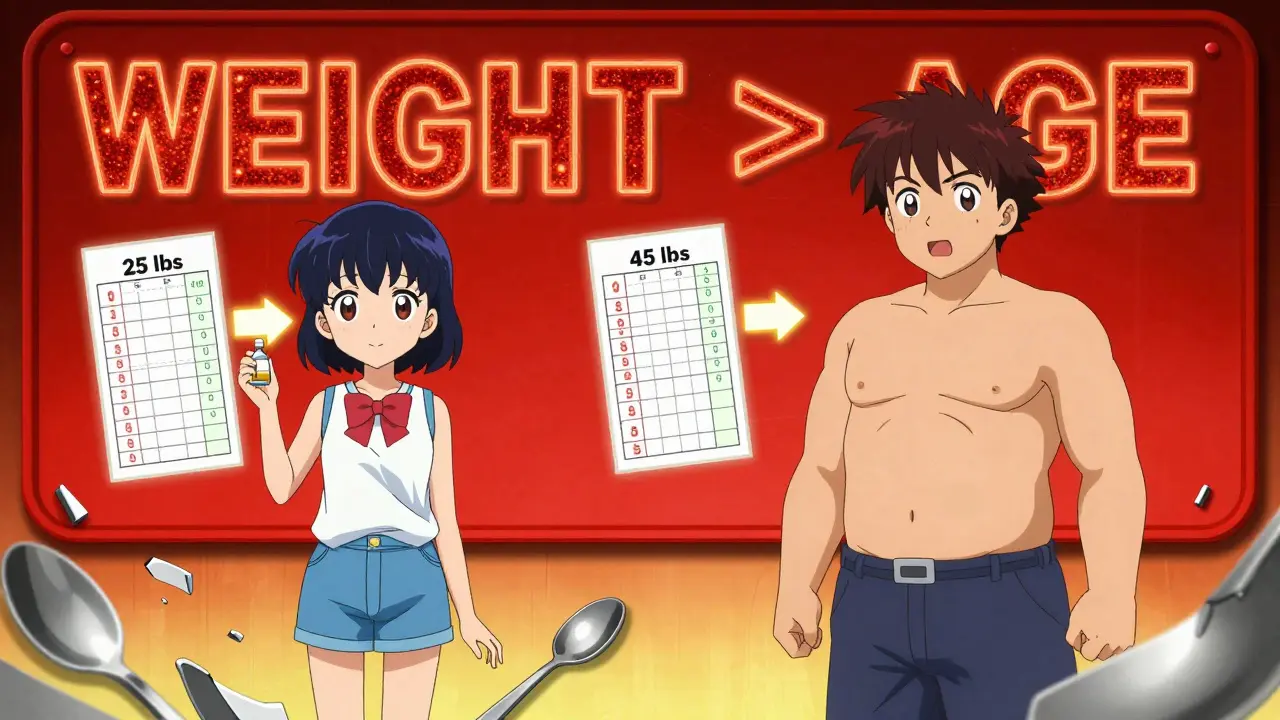
You’ll see age ranges on every children’s medicine bottle: "For children 2-3 years" or "For kids 4-5." But those are just rough guides. The real key is your child’s weight. Why? Because two kids who are both 3 years old can weigh 25 pounds or 45 pounds. Their bodies process medicine differently. A dose that’s safe for one could be too much for the other.
Studies show that using age instead of weight leads to dosing errors in 23% of cases. That means nearly one in four parents gives the wrong amount. Half of those errors are overdoses - which can damage the liver or cause serious side effects. The other half are underdoses, where the medicine doesn’t work at all. The American Academy of Pediatrics says: "The correct dose for your child is based on their weight, not their age." If you don’t know your child’s weight, use age as a backup. But if you have a scale - use it.
What’s on the Label: The Must-Read Parts
Don’t just glance at the front. Flip the bottle. Read every line. Here’s what to look for:
- Active ingredient - This tells you what’s in the medicine. For fever or pain, it’s usually acetaminophen (Tylenol) or ibuprofen (Advil, Motrin). Never mix these with other medicines that contain the same ingredient. Many cold and flu products also have acetaminophen. Giving both can cause a deadly overdose.
- Concentration - This is the most important number you’ll ever read. Liquid medicines come in different strengths. The standard for acetaminophen is 160 mg per 5 mL. That means each teaspoon (5 mL) has 160 mg of medicine. Some older bottles or infant drops might say 80 mg per 5 mL. If you use the wrong syringe, you could give double the dose. Always check this number. If it’s not listed, don’t use it.
- Dosing chart by weight - Look for a table that breaks down doses by pounds or kilograms. You’ll see ranges like: 12-17 lbs, 18-23 lbs, 24-35 lbs. Find your child’s weight in that chart. If they’re right between two ranges, go with the lower one. It’s safer.
- Dosing instructions - How often? How many times a day? Acetaminophen can be given every 4 hours, but no more than 5 times in 24 hours. Ibuprofen is given every 6-8 hours, no more than 4 times a day. Never go over the daily limit, even if the fever doesn’t break.
- Warnings - "Do not use for children under 6 months" for ibuprofen. "Do not combine with other medicines containing acetaminophen." "Do not use a kitchen spoon." These aren’t suggestions. They’re lifesavers.
Acetaminophen vs. Ibuprofen: Know the Difference
Not all OTC kids’ medicine is the same. Here’s how acetaminophen and ibuprofen compare:
| Feature | Acetaminophen | Ibuprofen |
|---|---|---|
| Best for | Fever, mild pain | Fever, swelling, pain (like earaches or sprains) |
| Minimum age | 2 months (with doctor approval) | 6 months |
| Concentration | 160 mg per 5 mL | 100 mg per 5 mL |
| Dosing frequency | Every 4 hours | Every 6-8 hours |
| Max daily doses | 5 doses in 24 hours | 4 doses in 24 hours |
| Key warning | Liver damage risk if overused | Stomach irritation, kidney risk |
One big mistake: parents think ibuprofen is "stronger," so they give more. But it’s not about strength - it’s about concentration. A 5 mL dose of ibuprofen (100 mg/5 mL) has less active ingredient than a 5 mL dose of acetaminophen (160 mg/5 mL). Always match the dose to the concentration on the label.
Never Use a Kitchen Spoon
"I used a teaspoon," is the most common excuse after a dosing error. But a kitchen teaspoon? It holds anywhere from 4 mL to 7 mL - sometimes more. That’s a 30% error right there. A child who should get 5 mL might get 7 mL. That’s 40% too much.
The label says "mL" - milliliters. That’s not a spoon. It’s a measurement you need a medical device for. Always use:
- A dosing syringe (with mL markings)
- A dosing cup (with clear lines)
- A measuring spoon labeled "mL" (not "tsp")
And never, ever guess. If the bottle came with a syringe, use it. If not, get one from the pharmacy. They’re free. A 5 mL syringe costs less than a coffee. It’s worth it.
What to Do When Weight Is Between Ranges
Your child weighs 27 pounds. The chart says: 24-35 lbs = 5 mL. Perfect. But what if they weigh 34.5 lbs? Still 5 mL. What if they weigh 36 lbs? Now you’re in the next range: 36-47 lbs = 6 mL. Easy.
But what if your child weighs 23.8 lbs? The chart says 18-23 lbs = 4 mL, and 24-35 lbs = 5 mL. Do you round up? No. Always round down. Give the lower dose. It’s safer. If the medicine doesn’t work after 4 hours, you can give another dose - you won’t overdose.
Also, if you’re unsure? Call your pediatrician. Don’t wait. A quick call can prevent a trip to the ER.
Red Flags: When the Label Doesn’t Make Sense
Some labels are still confusing. Watch out for:
- "Tsp" or "Tbsp" without mL numbers - avoid. The FDA requires mL, so if it’s not there, the product might be outdated.
- "Infant drops" with no clear instructions - these are 80 mg per 0.8 mL. If you use a children’s syringe, you’ll give 10x too much. Use only the dropper that came with it.
- "Children’s chewable tablets" - they’re often 80 mg each. A child who needs 160 mg needs two tablets. Don’t assume "one tablet = one dose."
- "Benadryl" - it’s not just for allergies. Some parents use it to help kids sleep. But it’s not approved for kids under 2. Even at 2, it can cause breathing problems. Only use it if your doctor says so.

What’s Changed in 2024
Labels are getting better - but not perfect. In 2024, the FDA and AAP made two big updates:
- All acetaminophen products now must include a bold Liver Warning for kids under 12. This is because accidental overdoses caused 47 cases of liver failure in 2023 alone.
- Weight-based dosing is now the gold standard. The AAP says: "If you know your child’s weight, use that. If you don’t, go by age." But they still stress: weight is always better.
Some new bottles now include QR codes that link to video instructions. That’s a good sign. In the next few years, all children’s medicines will come with built-in dosing syringes. Until then, you’ve got to be the one reading the label.
Real Mistakes Real Parents Made
Here are actual stories from parents who got it wrong:
- A mom gave her 2-year-old 15 mL of acetaminophen because she thought "tsp" meant "tablespoon." She gave 3x the dose. Her child was hospitalized.
- A dad used a kitchen spoon to give ibuprofen. His spoon held 7 mL. His child got 40% more than recommended. He didn’t know until the next day.
- A grandma gave her grandchild a "children’s cold medicine" and didn’t realize it had acetaminophen. She also gave Tylenol. The child’s liver was damaged.
These aren’t rare. They happen every day. The difference between safety and danger? One label. One second of attention.
Your Action Plan
Here’s what to do the next time you need to give medicine:
- Find your child’s weight (on a scale, not a guess).
- Check the label for the active ingredient.
- Look for the concentration (must say mg per mL).
- Match your child’s weight to the chart - round down if between ranges.
- Use only the dosing syringe or cup that came with the medicine - or buy a new one.
- Write down the time you gave the dose. Set a phone alarm if you need to give it again.
- Check all other medicines in the house. No double dosing.
That’s it. No guesswork. No stress. Just clear steps.
Can I use a kitchen spoon if I don’t have a dosing syringe?
No. Kitchen spoons vary too much. A tablespoon can hold 15 mL, but some hold 20 mL. A teaspoon might hold 4 mL or 7 mL. That’s a 50% error. Always use a medical dosing device - syringe, cup, or measuring spoon labeled in mL. They’re cheap and free at pharmacies.
What if my child’s weight isn’t on the chart?
Find the closest range. If your child is 34.5 lbs and the chart says 24-35 lbs = 5 mL, use 5 mL. If they’re 36 lbs and the next range is 36-47 lbs = 6 mL, use 6 mL. If you’re unsure, always go with the lower dose. You can give another dose in 4 hours if needed.
Can I give acetaminophen and ibuprofen together?
Yes - but only if you’re careful. Some doctors recommend alternating them for stubborn fevers. But you must track the timing. Give acetaminophen every 4 hours, ibuprofen every 6-8. Never give both at the same time. Write down each dose. Keep a log. And never exceed the daily max for either.
Is it safe to give children’s medicine to a baby under 2 months?
No. Never give acetaminophen or ibuprofen to a baby under 2 months without calling a doctor first. Fever in a newborn can be a sign of something serious. Don’t treat it with OTC medicine. Call your pediatrician or go to the ER.
Why do some labels say "infant drops" and others say "children’s liquid"?
Infant drops are more concentrated - 80 mg per 0.8 mL. Children’s liquid is less concentrated - 160 mg per 5 mL. If you use the wrong syringe, you’ll give too much. Always use the dropper that came with infant drops. Never use a children’s syringe on infant drops. The difference in volume is tiny, but the dose is 10 times higher.
Angie Datuin
February 11, 2026 AT 04:05I used to just guess with my twins, especially when they were sick and I was exhausted. Then one time I gave them both the same dose because they were both ‘about 28 lbs’ - turns out one was 23 and the other was 34. We ended up in the ER. Never again. Now I weigh them every time. It’s weird how much difference a few pounds makes. I keep a sticky note on the fridge with their weights and the dosing chart. It’s saved us more than once.
Camille Hall
February 13, 2026 AT 02:30For anyone new to this: always write down the time you give the medicine. I used to forget and give another dose too soon. Now I set a phone alarm for each one. Even if the kid seems fine, I wait. Better safe than sorry. Also, keep all meds out of reach - my toddler once found the ibuprofen bottle and shook it like a rattle. Scared the hell out of me.
Ritteka Goyal
February 14, 2026 AT 10:52OMG I just read this and I’m crying 😭 I’m from India and we don’t have these labels here - we just give whatever the pharmacist says and they say ‘2 tsp’ and we use a regular spoon. My cousin’s kid got liver damage last year because they gave him Tylenol AND a cold medicine that had it too. I’m sharing this with every mom group I’m in. We need to change this. Why does the US have such clear labels and we still use kitchen spoons? I’m so mad. My niece is 18 months and I’m buying a dosing syringe TODAY. I’m telling my sister to stop using the spoon. I’m telling my whole family. This is life or death.
Monica Warnick
February 15, 2026 AT 11:12Okay but have you seen the new labels? The ones with QR codes? I scanned one and it played a 3-minute video of a woman in scrubs saying ‘use the syringe’ in a voice that sounds like a Siri parody. I felt like I was being babysat by a robot. Also, why is the chart always in pounds? I’m a metric user. I had to Google ‘kg to lbs converter’ while holding a screaming toddler. Why can’t they just say 10 kg = 5 mL? Why do we have to do math? I hate this. Also, I used to think ‘infant drops’ were for newborns only. Turns out they’re just more concentrated. I gave my 4-month-old the children’s liquid because I thought it was ‘stronger.’ I was wrong. I’m still traumatized.
Frank Baumann
February 16, 2026 AT 13:32Let me tell you about the time I mixed ibuprofen and Tylenol because I thought ‘more medicine = faster cure.’ My kid’s fever went from 103 to 106 in 45 minutes. I panicked. Called 911. They said I overdosed him. He spent three days in the hospital. I didn’t even know the dosing limits. I thought ‘if one dose helps, two must be better.’ I’m not dumb - I’m just uninformed. Now I have a laminated chart taped to the medicine cabinet. I carry it in my purse. I show it to babysitters. I even made a poster for my mom’s house. If you’re reading this and you’ve ever given medicine without checking the label - you’re not alone. But you can change. Start today. Use the syringe. Weigh the kid. Don’t guess. I’m still scared every time I give a dose. But now I’m scared for the right reasons.
Lyle Whyatt
February 17, 2026 AT 16:31Just wanted to add - if you’re traveling internationally and need to give meds, bring your own syringe. I was in Thailand last year and the pharmacy gave me a bottle with no mL markings. Just ‘1 tsp.’ I had no idea what that meant. I ended up using my home syringe and writing the dose in permanent marker on the bottle. Also, don’t trust the ‘children’s’ label on imported meds. One brand I bought said ‘for ages 2-12’ but the concentration was 50 mg per 5 mL - half of what we use here. I almost gave my daughter a full teaspoon thinking it was normal. I’m lucky I checked. Always look for the mg/mL. That’s your only real guide. Age? Weight? Those are just hints. The number on the bottle? That’s gospel.
Tom Forwood
February 18, 2026 AT 04:34Biggest tip I learned? Never trust the cap. The cap might say ‘one cap = 5 mL’ but if you’ve ever used one, you know they’re never accurate. I used to fill the cap and then pour it into the syringe. One time I spilled half. My kid cried. I cried. Now I just use the syringe straight from the bottle. No cap. No guesswork. Also - if you’re using a syringe, don’t put it back in the bottle. That’s a recipe for contamination. Use a clean one each time. Or at least rinse it with water. I keep three syringes in a ziplock in the medicine drawer. One for Tylenol, one for Motrin, one for ‘just in case.’ I’m weirdly proud of my system. It’s saved my sanity.
Chelsea Cook
February 19, 2026 AT 13:08So I gave my kid the wrong dose because I thought ‘tsp’ meant ‘teaspoon’ and I used a fancy ceramic one that looked like a spoon but held 7 mL. My kid was fine. I was not. I cried for an hour. Then I bought a $3 syringe and taped it to the bottle with a sticky note that says ‘USE THIS OR I WILL YELL.’ It works. Also - why is Benadryl still sold as a sleep aid for kids? That’s not a thing. It’s a chemical sedative. My 3-year-old turned into a zombie once. We had to carry him to bed. Don’t do it. Just don’t. Ever. Unless your pediatrician says so. And even then - maybe don’t.
Jacob den Hollander
February 21, 2026 AT 11:54I just want to say thank you for this. I’m a single dad. My daughter’s 5. I’ve been scared to give her medicine since she was a baby. I didn’t trust myself. I’d read the label, then read it again, then read it again. I’d call my mom. Then my sister. Then my doctor. I felt like I was failing. This post? It’s the first time I felt like I actually understood. I printed it. Laminated it. Put it in a sleeve next to the medicine. Now I weigh her every time. I use the syringe. I write down the time. I don’t panic. I just do it. And it’s… easier. I didn’t know I needed this. But I did. Thank you.
Joseph Charles Colin
February 23, 2026 AT 04:48From a clinical pharmacist perspective: the 160 mg/5 mL concentration standardization was a watershed moment in pediatric pharmacovigilance. Prior to 2011, there were over 30 distinct formulations of acetaminophen on the market, with concentrations ranging from 80 mg/mL to 160 mg/5 mL - a 10-fold variation. This led to catastrophic dosing errors, particularly when caregivers misinterpreted ‘infant drops’ as ‘children’s suspension.’ The AAP’s 2011 recommendation to unify concentrations under 160 mg/5 mL reduced ER visits for acetaminophen toxicity by 42% within 18 months. The QR code initiative is a step toward contextual dosing education, though it remains underutilized. Bottom line: weight-based dosing is not merely preferred - it is the pharmacokinetic gold standard. Always verify the active ingredient, concentration, and body weight before administration. Failure to do so constitutes a preventable iatrogenic event.