
Warfarin & NSAID Bleeding Risk Calculator
NSAID Selection
Bleeding Risk Assessment
Select an NSAID to see the bleeding risk
Safe Pain Relief Alternatives
Acetaminophen (Tylenol) is the safest option - it doesn't affect platelets or the stomach lining. Use up to 3,000 mg/day max, and avoid alcohol.
Topical pain relievers like diclofenac gel or lidocaine cream are much safer since very little enters the bloodstream.
Consider physical therapy or heat/cold therapy for chronic pain management.
When you're on warfarin to prevent blood clots, even a simple over-the-counter painkiller can turn dangerous. Mixing warfarin with NSAIDs-like ibuprofen, naproxen, or even celecoxib-can double your risk of serious, sometimes fatal, bleeding. This isn't a rare edge case. It's happening to hundreds of thousands of people every year, often without them even realizing it. And the danger doesn't stop at the stomach. Bleeding can happen in the brain, lungs, kidneys, or anywhere else in your body. If you or someone you know is taking warfarin, you need to understand exactly why NSAIDs are so risky-and what to do instead.
How Warfarin and NSAIDs Work Together to Increase Bleeding Risk
Warfarin doesn't just make your blood thinner. It works by blocking vitamin K, which your liver needs to make clotting factors. Without those factors, your blood can't form clots easily. That's good if you're at risk for stroke or a pulmonary embolism. But it becomes dangerous when another drug starts attacking your body's backup systems.
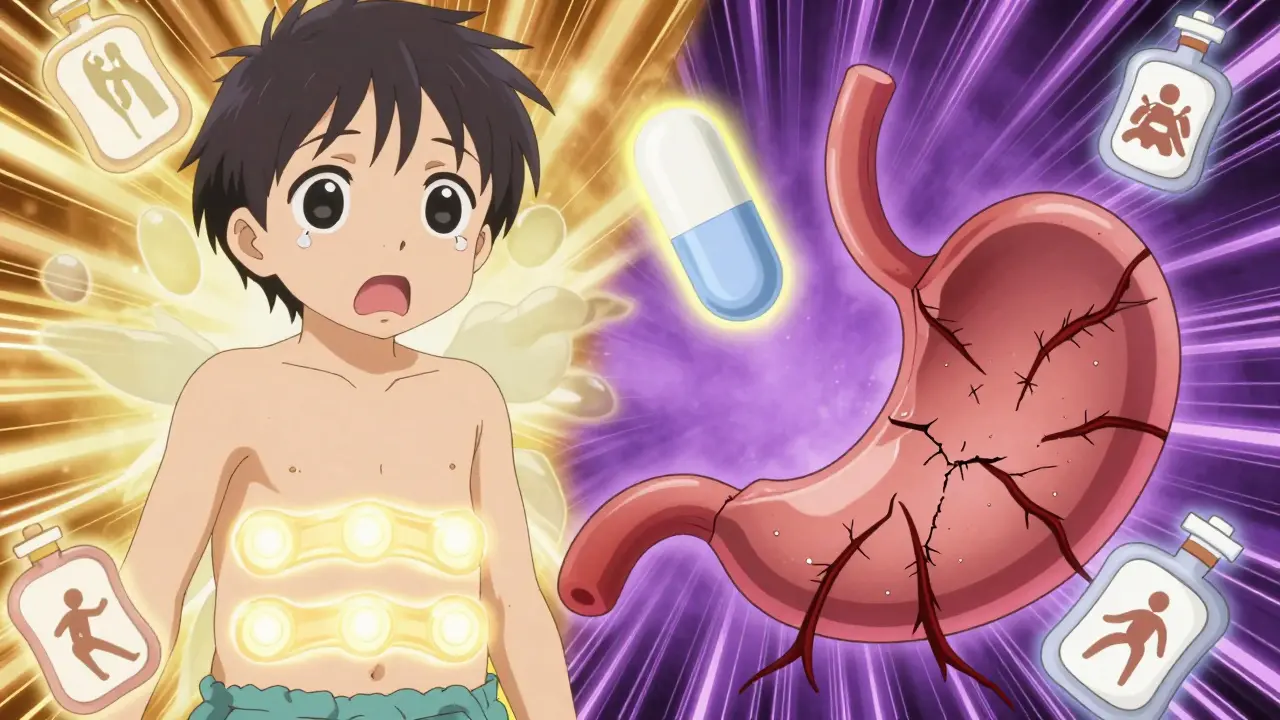
NSAIDs, on the other hand, work by shutting down enzymes called COX-1 and COX-2. COX-1 helps protect the lining of your stomach. When it's blocked, your stomach becomes more vulnerable to ulcers. COX-2 is involved in inflammation and pain-but it also helps platelets stick together. When NSAIDs stop COX-2, your platelets can't clump up to seal a cut. That means even a tiny bleed doesn't stop on its own.
Put them together, and you get a perfect storm: warfarin reduces your ability to form clots, while NSAIDs stop your platelets from working and damage your stomach lining. The result? Bleeding that starts easily and doesn't stop. Studies show this combination increases your overall bleeding risk by more than two times compared to warfarin alone.
Not All NSAIDs Are Created Equal
Some NSAIDs are far more dangerous than others when taken with warfarin. It's not just about the dose-it's about the drug itself.
- Naproxen carries the highest risk-over 4 times greater bleeding than warfarin alone.
- Diclofenac is almost as bad, increasing risk by 3.3 times.
- Meloxicam is especially risky for people on high doses of warfarin. One study found it triggered dangerous INR spikes in nearly 40% of users.
- Ibuprofen is often thought to be "safer," but it still raises bleeding risk by nearly 1.8 times.
- COX-2 inhibitors like celecoxib? Don't be fooled. They're just as dangerous as traditional NSAIDs when paired with warfarin. The idea that they're gentler on the stomach? Doesn't hold up when you're on a blood thinner.
The risk isn't just theoretical. A 2023 analysis of real-world data from over 5,000 warfarin users showed that those who took naproxen had nearly twice the rate of hospitalization for bleeding compared to those who didn't take any NSAID. The same pattern held for diclofenac and meloxicam.
Bleeding Isn't Just About Your Stomach
Most people think NSAIDs and warfarin only cause stomach bleeds. They're wrong. The risk spreads across your whole body.
- Gastrointestinal bleeding: 2.24 times more likely.
- Intracranial bleeding (brain bleed): 3.22 times more likely. This is often fatal.
- Pulmonary bleeding: 1.36 times more likely. Can lead to coughing up blood or sudden shortness of breath.
- Urinary tract bleeding: 1.57 times more likely. May show up as blood in urine.
One patient in a 2021 case study dropped from a hemoglobin level of 14 to 8 in just 24 hours after taking ibuprofen for a headache. That’s a severe drop-equivalent to losing over a liter of blood. He ended up in the ER, needed a transfusion, and spent five days in the hospital. He had no warning signs. No pain. No nausea. Just sudden weakness.
Why NOACs Don't Solve the Problem
Many people switch from warfarin to newer blood thinners like apixaban, rivaroxaban, or dabigatran thinking they're safer. But the truth? NSAIDs are just as dangerous with these drugs.
A 2019 study in Circulation found that NSAID use with any oral anticoagulant-warfarin or NOACs-led to the same spike in major bleeding. While apixaban had slightly lower bleeding rates overall, the increase from NSAIDs was still significant. In fact, a 2023 study showed that NSAID use with NOACs has actually increased as more people switch from warfarin. That’s a dangerous misconception: thinking "newer drug = safer with NSAIDs." It's not true.
Even dabigatran, which has fewer drug interactions, still shows a doubled risk of gastrointestinal bleeding when combined with NSAIDs. The idea that NOACs are "drug-interaction free" is a myth. They're just different. And NSAIDs still wreck your platelets and stomach lining regardless of what anticoagulant you're on.
Real-World Consequences: What Happens When People Ignore the Warning
The FDA's adverse event database recorded over 1,800 bleeding events tied to warfarin-NSAID combinations between 2015 and 2020. Over 60% of those were gastrointestinal. But 15% were brain bleeds. And 8% were lung bleeds.
On patient forums, stories flood in:
- "Took Advil for my back pain. Woke up vomiting blood. ER said my INR was 9.8. I was lucky to survive."
- "My mom was on warfarin. Took naproxen for arthritis. Had a stroke. They said the NSAID caused it."
- "I didn't tell my doctor I was taking ibuprofen. I thought it was harmless. Ended up in ICU."
These aren't outliers. A 2021 study of 5,237 warfarin users found that 78% of those who bled while taking NSAIDs needed hospitalization. Their average stay? Over five days. That's more than a week of pain, tests, transfusions, and recovery. And it cost the system over $1.8 billion a year in the U.S. alone.

What to Do Instead: Safer Pain Relief Options
You don't have to suffer pain just because you're on warfarin. There are alternatives.
- Acetaminophen (Tylenol): This is the gold standard for pain relief on warfarin. It doesn't affect platelets or the stomach lining. Studies show it has no significant interaction with warfarin. Use the lowest effective dose (max 3,000 mg/day), and avoid alcohol.
- Topical pain relievers: Gels, creams, or patches with diclofenac or lidocaine. Since they're absorbed through the skin, they don't hit your bloodstream the same way. They're much safer. Sales of these products have grown 12.7% annually among warfarin users.
- Physical therapy: For chronic pain from arthritis or back issues, movement and strengthening exercises reduce pain better than pills. Many patients find long-term relief without any drugs.
- Heat and cold therapy: Simple, free, and effective. A heating pad for stiff joints, ice for swollen knees.
Even if you think "just one pill" won't hurt, it can. There's no safe dose of NSAID when you're on warfarin. The risk isn't linear-it's exponential. One pill might not do anything today. But tomorrow, your INR might be higher. Or your stomach lining might be thinner. Or your platelets might be more sluggish. You won't know until it's too late.
What Doctors Should Do: Monitoring and Prevention
Even if a doctor prescribes an NSAID, they should know better. The American College of Cardiology and the American Heart Association both say NSAIDs should be avoided entirely in patients on oral anticoagulants. Class I recommendation. Level B evidence. That means: strong, clear, and based on solid data.
If an NSAID is absolutely unavoidable-for example, after a flare-up of rheumatoid arthritis-then these steps are non-negotiable:
- Use the lowest possible dose for the shortest possible time (no more than 3-5 days).
- Avoid naproxen, diclofenac, and meloxicam. If you must use an NSAID, ibuprofen is the least bad-but still risky.
- Check your INR before starting the NSAID.
- Check it again 3-5 days after starting. Then weekly until stopped.
- Take a proton pump inhibitor (like omeprazole) to protect your stomach.
- Teach the patient to recognize bleeding signs: black stools, vomiting blood, sudden headaches, unexplained bruising, blood in urine.
But here's the problem: 68% of patients don't tell their doctors they're taking over-the-counter NSAIDs. And 42% of U.S. hospitals don't have electronic alerts to warn doctors when warfarin and NSAIDs are prescribed together. That's a system failure. And it's costing lives.
Why This Keeps Happening: Misinformation and Lack of Awareness
Why do so many people still take NSAIDs with warfarin? Because the message is muddled.
- Drug labels on NSAIDs often say "risk of bleeding" but don't mention warfarin specifically.
- Pharmacists don't always screen for anticoagulant use when selling OTC painkillers.
- Patients assume "if it's sold over the counter, it's safe." It's not.
- Some doctors still believe "low-dose ibuprofen is fine." It's not.
Even the FDA's black box warning from 2005 didn't stop the practice. A 2023 study found that 42.6% of warfarin users still get NSAID prescriptions every year. That's over 1.3 million people. In Australia, where I live, the numbers are similar. The problem is global. And it's not going away.
The only solution? Education. Clear, repeated, and loud. Patients need to know: NSAIDs and warfarin don't mix. Period. Doctors need better alerts. Pharmacies need mandatory checks. And everyone needs to stop thinking "it's just a little pain"-because sometimes, that little pain leads to a big bleed.
Can I take ibuprofen if I'm on warfarin?
No. Even though ibuprofen is considered the "least risky" NSAID, it still increases your bleeding risk by nearly 1.8 times when taken with warfarin. There is no safe dose. If you need pain relief, use acetaminophen (Tylenol) instead. If you've already taken ibuprofen, check your INR immediately and watch for signs of bleeding like dark stools, vomiting blood, or sudden bruising.
Is Tylenol safe with warfarin?
Yes, acetaminophen (Tylenol) is the safest painkiller to use with warfarin. It doesn't affect platelets or the stomach lining. Stick to 3,000 mg per day max, and avoid alcohol, as high doses of acetaminophen can still harm your liver-especially if you're on long-term warfarin. But otherwise, it's your best option.
What about topical NSAIDs like diclofenac gel?
Topical NSAIDs are much safer than oral ones because very little enters your bloodstream. Studies show they don't significantly raise INR or bleeding risk. If you have joint pain, creams or patches with diclofenac or lidocaine are a good alternative. Just avoid applying them over large areas or for long periods without checking with your doctor.
Do newer blood thinners like Eliquis or Xarelto have fewer NSAID interactions?
No. While NOACs like apixaban (Eliquis) and rivaroxaban (Xarelto) have fewer drug interactions overall, combining them with NSAIDs still doubles your risk of bleeding. The platelet and stomach-lining damage from NSAIDs doesn't care what anticoagulant you're on. Avoid NSAIDs regardless of whether you're on warfarin, Eliquis, or any other blood thinner.
What should I do if I accidentally took an NSAID while on warfarin?
Call your doctor or anticoagulation clinic immediately. Get your INR checked within 24-48 hours. Watch closely for signs of bleeding: black or tarry stools, vomiting blood, severe headaches, dizziness, unexplained bruising, or blood in urine. If any of these happen, go to the ER. Don't wait. Even one dose can trigger a dangerous bleed.

Jayanta Boruah
February 20, 2026 AT 19:49The data presented here is unequivocal: NSAIDs and warfarin represent a pharmacological collision of catastrophic proportions. The COX-1 inhibition-induced gastric mucosal vulnerability, compounded by warfarin’s vitamin K antagonism, creates a pro-hemorrhagic milieu that is neither marginal nor idiosyncratic. The 2.24-fold increase in GI bleeding, coupled with a 3.22-fold elevation in intracranial hemorrhage, constitutes a Class I contraindication by any clinical standards. The notion that low-dose ibuprofen is "tolerable" is a dangerous fallacy perpetuated by outdated medical education and pharmaceutical marketing. There is no threshold below which this interaction becomes benign. The exponential risk curve is non-linear, non-predictable, and unforgiving.
Furthermore, the persistence of this behavior-42.6% of warfarin users still receiving NSAIDs annually-is not merely a patient compliance issue; it is a systemic failure of prescriber education, pharmacy screening protocols, and regulatory labeling. The FDA’s black box warning, issued in 2005, has been rendered inert by cultural normalization of OTC drug use. This is not a clinical dilemma-it is a public health emergency.
Hariom Sharma
February 22, 2026 AT 00:18Bro, I felt this in my bones. My uncle was on warfarin after his heart valve replacement, took ibuprofen for his knee pain, and ended up in the ER with black stools. He’s fine now, but man-what a scare. I told everyone in my family: NO NSAIDs. Tylenol only. And if you’re gonna take anything else, check with your doc first. Seriously, don’t be that guy. Your body ain’t a lab experiment.
Nina Catherine
February 22, 2026 AT 01:06OMG I just realized I’ve been taking Advil for my headaches while on warfarin for AFib 😱 I had no idea!! I’m calling my pharmacist right now. Thanks for laying this out so clearly-I didn’t even know topical diclofenac was an option. That’s actually kinda genius. I’m gonna try the gel instead. Also, Tylenol is my new bestie. 🙌
Taylor Mead
February 22, 2026 AT 18:01Interesting breakdown. I’ve seen this play out in clinic-patients swear they "only took one" and then panic when they get a spike in INR. The thing no one talks about is how hard it is to find alternatives for chronic pain. Acetaminophen doesn’t cut it for some folks. Topical stuff helps, but it’s not magic. Physical therapy? Great, if you’ve got the time, money, and access. For a lot of people, especially in rural areas? Not feasible. We need better solutions, not just warnings.
Amrit N
February 24, 2026 AT 13:57So I’ve been on warfarin for 8 years now. Used to take naproxen for my back. Then one day I woke up with bruises all over my arms. Didn’t even bump into anything. Scared the crap outta me. Started using Tylenol and a heating pad. Life’s been way better since. Also, my doc never told me about the topical gels-found out from Reddit. Y’all are lifesavers. Thanks for the info.
Robert Shiu
February 26, 2026 AT 08:04This is such an important post. I’ve worked in anticoagulation clinics for over a decade, and this interaction is STILL the #1 cause of preventable bleeds. Patients don’t think OTC means "risky." They think "I can buy it without a prescription" means "safe." That’s the gap we need to bridge. We need pharmacy-led education-like when they hand you your prescription, they should say: "Don’t take Advil with this." Simple. Direct. Mandatory. And yeah, topical NSAIDs are underrated. I’ve seen patients go from constant pain to zero bleeding just by switching to diclofenac cream. Small change. Big difference.
Scott Dunne
February 27, 2026 AT 19:34It’s disgraceful how lax American medicine has become. In Ireland, we have strict protocols: no NSAIDs on anticoagulants, period. No exceptions. Pharmacists are trained to flag this. Doctors are penalized for prescribing it. Yet here, we let people gamble with their lives because they "just wanted to feel better." This isn’t healthcare-it’s negligence dressed up as choice. Wake up.
Ashley Paashuis
March 1, 2026 AT 16:07Thank you for highlighting the NOAC misconception. So many patients assume that because they switched from warfarin, they can now "safely" use NSAIDs. The data shows otherwise. I’ve counseled dozens of patients who thought Eliquis was "cleaner"-only to end up with a GI bleed after taking naproxen. The mechanism isn’t about drug interactions per se; it’s about platelet dysfunction and mucosal damage. Those don’t care what anticoagulant you’re on. Education must be restructured around mechanism, not brand names.
Marie Crick
March 2, 2026 AT 20:12One dose. That’s all it takes. I lost my sister because she took a single ibuprofen. She didn’t even know it was dangerous. Don’t be her. Stop. Just stop.