
Why do so many patients keep taking expensive medications-even when cheaper, equally effective options are available? It’s not about ignorance. It’s not about laziness. It’s about how the human brain actually works.
The Myth of the Rational Patient
For decades, doctors and policymakers assumed patients made drug choices like economists: weighing costs, benefits, and risks to pick the best option. But real life doesn’t work that way. A 2022 study found that 68% of patients stick with their current prescription-even if a similar drug costs 30% less. Why? Because switching feels risky. Even if the science says it’s safe, the mind says: What if something goes wrong? This isn’t irrational. It’s human. Behavioral economics shows us that people don’t make decisions based on logic alone. They’re shaped by emotions, habits, and subtle cues in the environment. And when it comes to medicine, those cues can mean the difference between healing and hospitalization.Loss Aversion: The Fear of Letting Go
People hate losing more than they love gaining. That’s loss aversion-and it’s one of the biggest barriers to better medication use. Imagine you’ve been on a brand-name drug for two years. Your doctor says there’s a generic that works just as well and saves you $50 a month. You know it’s safe. You’ve read the studies. But you still hesitate. Why? Because you’re not just choosing a pill-you’re choosing to give up the feeling of control, familiarity, and stability you’ve built around your current treatment. A 2022 analysis by Dr. Khullar found that only half of patients take their meds as prescribed. Loss aversion is a major reason. Patients don’t think, “This drug is too expensive.” They think, “If I switch, I might lose what’s working for me.” Clinics that use this insight have started framing changes differently. Instead of saying, “We’re switching you to a cheaper option,” they say, “Let’s try this option together-it’s been helping others keep their health on track.” That small shift reduces the sense of loss.Present Bias: Tomorrow’s Health Doesn’t Feel Real
You know you need to take your blood pressure pill every day. But today, you feel fine. So you skip it. Tomorrow, you’ll take it. But tomorrow never comes. This is present bias-the brain’s stubborn preference for immediate comfort over future rewards. It’s why 33% of prescriptions are never even filled after being written. Patients with diabetes, high cholesterol, or arthritis often don’t feel symptoms until things go wrong. So their brain says: No pain, no need. The fix? Make the future feel closer. A 2021 study showed that SMS reminders saying, “Don’t lose your streak!” improved adherence by nearly 20%. Why? Because people don’t want to break a chain. They want to feel consistent. The message didn’t explain the science-it tapped into identity and routine.Defaults: The Silent Power of Pre-Selected Options
What’s the easiest choice? The one already selected for you. In a 2012 hospital study, doctors were given two options when prescribing a drug during a shortage: the usual brand or a substitute. When the substitute was pre-selected as the default, appropriate switching jumped by 37.8%. No one forced them. No one nagged them. They just went with the default. This isn’t manipulation. It’s design. The same principle works for patients. When pharmacies auto-fill refills for chronic meds, refill rates go up. When formularies list preferred drugs first, doctors prescribe them more often. The FDA’s 2023 guidance now requires drug makers to consider how dosing schedules and packaging affect patient choices. That’s behavioral economics in policy-and it’s changing how medicines reach people.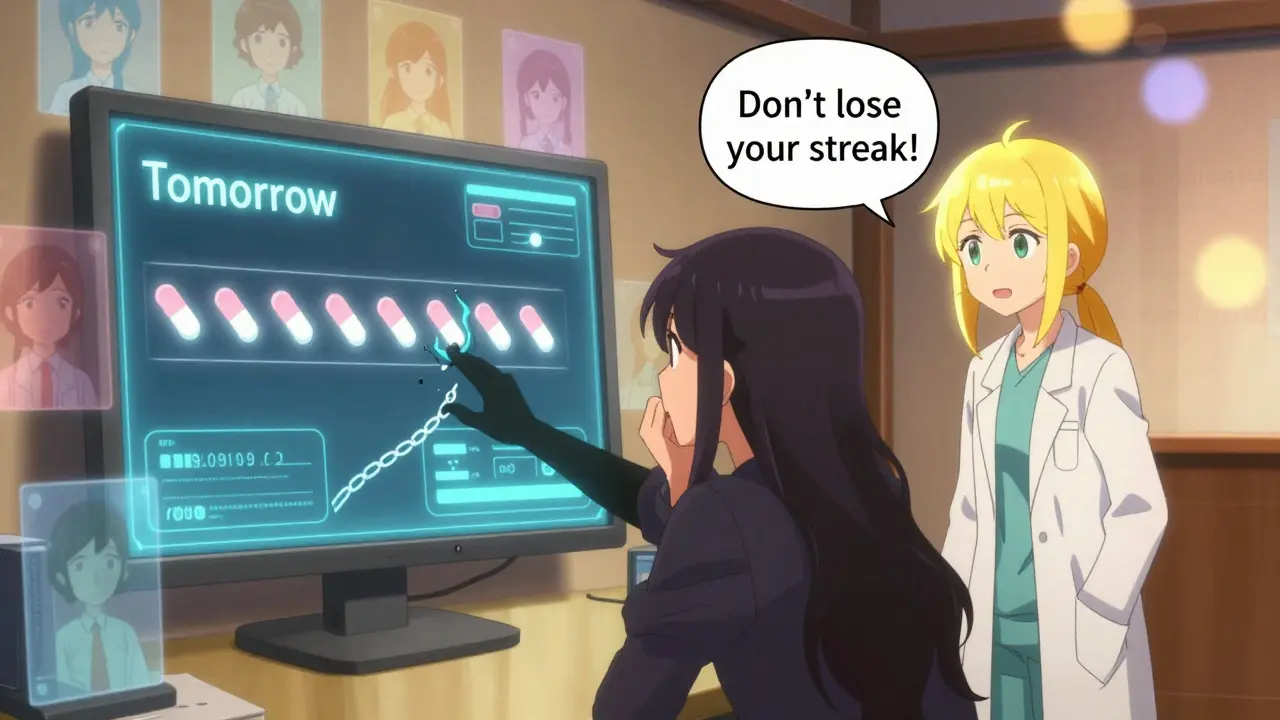
Framing: How Words Shape Choices
Say a vaccine is 95% effective. Most people say yes. Say it has a 5% chance of failure. Many say no. Same facts. Different words. Different choices. That’s framing. And it’s powerful in medicine. A 2021 trial showed that patients were 18.4 percentage points more likely to get vaccinated when told the vaccine was “95% effective” instead of “5% ineffective.” Pharmaceutical companies are using this in patient support programs. Instead of saying, “Don’t miss your dose,” they say, “Stay on track-your health depends on it.” Instead of “This drug has side effects,” they say, “Most people tolerate this well.” It’s not lying. It’s clarity. It’s choosing the words that match how people actually think.Social Proof: We Follow the Crowd
We care what others are doing-even if we won’t admit it. In one HIV clinic, staff put up a poster showing monthly adherence rates: “This month, 89% of our patients took all their meds.” The result? Adherence jumped 22.3%. People don’t want to be the outlier. They want to belong. When patients see others succeeding, they believe they can too. Hospitals are now using digital dashboards to show real-time adherence stats. Pharmacies send texts like, “Over 90% of patients like you refill on time.” These aren’t guilt trips-they’re gentle reminders that you’re not alone.Why Education Alone Fails
For years, the go-to solution was: give patients more information. Brochures. Websites. Videos. Pamphlets. But here’s the truth: education alone improves adherence by only 5-8%. Behavioral interventions? They improve it by 14-28%. Why? Because knowing what to do isn’t the same as doing it. You know you should exercise. You know you should eat less sugar. But knowing doesn’t change behavior. Behavioral economics works because it doesn’t fight human nature-it works with it.
Barriers That Can’t Be Nudged Away
Not every problem can be solved with a nudge. Patients with severe depression or anxiety are 31.4% less responsive to behavioral interventions. Those on multiple medications-polypharmacy-see adherence drop by 8.3% for each extra pill. And if there’s no real alternative? Like with certain cancer drugs-there’s no “cheaper option” to nudge toward. That’s why one-size-fits-all doesn’t work. The best programs tailor nudges to the person. Someone with anxiety needs reassurance. Someone with a busy schedule needs simplicity. Someone with negative beliefs about meds needs trust-building, not reminders.Technology and the Future of Drug Choices
Smart pill bottles that light up when it’s time to take a pill. Apps that track adherence and give badges. AI that predicts who’s likely to skip a dose and sends a personalized message. These tools are growing fast. A 2023 pilot showed machine learning could predict individual response to nudges with 42.3% accuracy-meaning you could get the right nudge, for the right person, at the right time. But tech alone isn’t enough. A smart bottle costs $47.50 per patient per month. A simple text message costs $8.25. The most effective programs combine low-cost nudges with smart targeting.What Works Now-and What Doesn’t
Here’s what the data shows works best:- Defaults: Pre-selecting the preferred option in prescriptions or refill systems.
- Loss aversion: Framing adherence as protecting what you’ve already gained.
- Social norms: Showing how others are succeeding.
- Simple framing: Saying “95% effective” instead of “5% risk.”
- Long, dense educational materials.
- Generic reminders like “Take your medicine.”
- Shaming patients for non-adherence.
- Assuming cost is the main barrier.
The Bigger Picture
Medication non-adherence costs the U.S. healthcare system $289 billion a year-and causes 125,000 preventable deaths. That’s not a drug problem. It’s a human problem. Behavioral economics doesn’t blame patients. It doesn’t demand they be perfect. It asks: What’s making it hard? And how can we make the right choice easier? That’s the shift happening in pharmacies, clinics, and drug companies. It’s not about changing minds. It’s about changing the environment. And that’s how real change happens.Why do patients stick with expensive drugs even when cheaper options exist?
Patients often stick with expensive drugs because of psychological factors like loss aversion-they fear losing what feels familiar-even if the cheaper option is just as effective. Confirmation bias also plays a role, where people believe more expensive equals better. Studies show 68% of patients won’t switch even when a 30% cost savings is available.
How does behavioral economics improve medication adherence?
Behavioral economics improves adherence by designing small, smart changes-called nudges-that align with how people actually think. Examples include setting defaults to preferred medications, using loss-framed messages like “Don’t lose your streak!”, showing social norms (“Most patients like you take their meds”), and simplifying choices. These approaches improve adherence by 14-28%, far more than education alone.
Are behavioral interventions ethical?
Yes, when they preserve freedom of choice. Behavioral nudges don’t force people-they make the better option easier to choose. For example, pre-selecting a generic drug doesn’t stop a doctor from choosing the brand; it just makes the default the smarter one. Experts like Dr. Aaron Kesselheim say these interventions respect autonomy while guiding better outcomes.
Can behavioral economics help with drug shortages?
Yes. During shortages, hospitals that changed their electronic order sets to default to available alternatives saw 37.8% more appropriate substitutions. Behavioral design helps clinicians make quick, safe choices under pressure without needing to rethink every prescription.
Why don’t patient education programs work well?
Education tells people what to do-but doesn’t help them do it. People know they should take their meds. The problem is forgetting, feeling overwhelmed, or fearing side effects. Behavioral interventions work on action, not knowledge. A 2022 review found behavioral approaches improved prescribing in 92% of cases, while education only boosted adherence by 5-8%.
What’s the biggest mistake in designing drug adherence programs?
Assuming one size fits all. A patient with depression needs different support than someone with a busy schedule or negative beliefs about meds. The most successful programs use data to match nudges to individual barriers-like using SMS for forgetfulness, or trust-building conversations for those with medication skepticism.
Do behavioral interventions work for chronic conditions like diabetes?
Yes-especially for conditions with regular, predictable dosing like diabetes. These are ideal for behavioral nudges because the routine is clear. Programs using reminders, defaults, and loss-framed messaging have seen adherence rates rise by over 25%. Diabetes has the highest adoption of behavioral interventions (47.8%) because the behavioral patterns are easy to target.
How do insurance companies use behavioral economics?
Many insurers now use behavioral design in their formularies. They place preferred drugs at the top of lists, offer small rebates for adherence, or structure copays to make generics feel like the obvious choice. Twenty-seven of the 30 largest pharmacy benefit managers now include behavioral elements in how they design coverage.
Is behavioral economics just for rich countries?
No. While most research comes from the U.S. and Europe, the principles apply everywhere. Simple, low-cost nudges-like SMS reminders or community health worker follow-ups-work in low-resource settings too. The key isn’t technology-it’s understanding human behavior.
What’s next for behavioral economics in healthcare?
The future is personalization. AI is being trained to predict which nudge works best for each patient-based on their history, habits, and even personality. Combined with digital tools like smart pill bottles and real-time feedback, this could boost adherence by over 40%. The goal isn’t to control patients-it’s to support them in the way they actually live.

Ashok Sakra
January 21, 2026 AT 09:35This is why I hate how doctors treat us like robots. I took my cheap generic and felt like crap for a week. My body knew the brand. It didn't care about the science. I'm not stupid, I just don't want to gamble with my health.
They act like it's a choice. It's not. It's fear. And fear doesn't listen to studies.
Andrew Rinaldi
January 22, 2026 AT 21:06It's fascinating how much of our behavior is shaped by invisible forces. We think we're rational, but we're just pattern-following animals trying to minimize discomfort. The real insight here isn't about drugs-it's about how little control we actually have over our own decisions.
Maybe the goal shouldn't be to 'fix' patients, but to design systems that work with our flaws instead of fighting them.
michelle Brownsea
January 23, 2026 AT 07:03Let’s be clear: this isn’t ‘behavioral economics’-it’s manipulation dressed up as science. You’re telling doctors and pharmacies to trick people into compliance by exploiting cognitive biases. That’s not ethics-that’s psychological coercion under the guise of ‘nudges.’
And don’t pretend ‘preserving freedom of choice’ means anything when the default is engineered to steer behavior. You’re not helping; you’re conditioning.
Melanie Pearson
January 24, 2026 AT 07:26It’s pathetic that we’ve reduced human health to a behavioral algorithm. In America, we’ve turned medicine into a marketing campaign. We don’t fix systems-we tweak formularies and slap on buzzwords like ‘nudge’ to avoid real reform.
People don’t need framing-they need affordable drugs. Period. This whole article is a distraction from the fact that pharmaceutical companies are gouging patients and we’re too lazy to fix it.
Uju Megafu
January 25, 2026 AT 06:51Oh wow, so now we’re blaming the patient for being scared? What about the 50% of people who can’t even afford the ‘cheaper’ option? You talk about loss aversion like it’s some cute psychological quirk.
Try losing your job, your insurance, and your dignity all at once-and then tell me why you’re not clinging to the only thing that makes you feel safe.
This isn’t behavioral economics. It’s capitalism pretending to care.
Jarrod Flesch
January 26, 2026 AT 03:22Yesss!! This is so real. I used to skip my meds till my doc started sending me a text like ‘You got a 7-day streak going-don’t break it!’ 😊
Now I feel like a champ every time I take it. No lectures. No guilt. Just a little nudge. It works.
Also, my pharmacist auto-fills my refills now. Best thing ever. I don’t even think about it anymore. 🙌
Kelly McRainey Moore
January 27, 2026 AT 18:07I love how this flips the script. Instead of yelling at patients for being non-compliant, we’re asking: what’s making it hard? That’s just… kind. And smart.
My grandma used to forget her pills till we put them in a little weekly box with pictures. She didn’t need a pamphlet. She needed simplicity.
Small things matter so much.
Stephen Rock
January 29, 2026 AT 12:40So we’re just gonna keep pretending that people are dumb and need to be nudged like lab rats?
Meanwhile, the real problem is drug prices, insurance loopholes, and corporate greed.
This whole thing is a distraction. A pretty, pseudo-scientific distraction.
Stop playing therapist. Fix the system.
Amber Lane
January 31, 2026 AT 08:26Defaults work because they reduce decision fatigue. That’s it.
People aren’t dumb. They’re tired.
And when you’re juggling work, kids, bills, and chronic pain-you don’t have mental bandwidth for pharmacy debates.
Make the right choice the easy one. Done.
Gerard Jordan
February 2, 2026 AT 02:30Just saw a study last week-patients who got a personalized video message from their own doctor saying, ‘I know this is hard. I’m here with you.’-had 34% higher adherence than those who got generic texts.
It’s not just about nudges. It’s about connection.
Technology helps. But humanity? That’s the real drug.
❤️