
When someone moves into a nursing home, people often assume their long-term care insurance will cover everything - including the pills they take every day. But here’s the truth: long-term care insurance does not cover prescription drugs, not even generic ones. That’s not a loophole. It’s by design.
If you or a loved one is in a nursing home, the medications you rely on - whether it’s a generic blood pressure pill, a diabetes tablet, or a simple antibiotic - are paid for by something else entirely. And that something else? It’s usually Medicare Part D. Not long-term care insurance. Not Medicaid. Not private health plans. Medicare Part D is the main engine behind drug coverage in nursing homes today.
Why long-term care insurance won’t pay for your pills
Long-term care insurance was never meant to cover medical treatments. It covers the cost of daily help - bathing, dressing, eating, moving around - when you can’t do it yourself. Think of it as paying for a caregiver, not a pharmacist. The policy might cover your room, your meals, and your personal care staff, but your pills? Those are medical supplies, and medical supplies fall under health insurance.
This split isn’t new. Since the 1970s, when long-term care insurance first became popular, insurers made it clear: we pay for care, not medicine. When Medicare Part D launched in 2006, it didn’t replace this rule - it reinforced it. Now, if you’re in a nursing home and taking medications, your long-term care insurance stays out of the picture. Your Medicare Part D plan steps in. Or Medicaid. Or, in rare cases, your private health plan.
Who actually pays for generic drugs in nursing homes?
Let’s cut through the noise. In 2020, a study of over 29,000 nursing home residents found that 82.4% of prescription drug costs were covered by Medicare Part D. That’s more than four out of five residents. Medicaid paid for 11.2%. Private insurance? Just 8.5%. Veterans Affairs? Barely 0.2%. And nearly 9% - that’s over 2,600 people in that study alone - paid for their own meds out of pocket.
Generic drugs make up about 90% of all prescriptions in nursing homes. They’re cheaper, just as effective, and preferred by most plans. But here’s the catch: even if a drug is generic, it still needs to be on your plan’s formulary. A formulary is just a list of drugs your plan agrees to cover. If your doctor prescribes a generic drug that’s not on that list, you might get stuck.
Some plans will let you get a non-formulary drug for up to 180 days - but only if they feel like it. There’s no legal requirement. That means a resident could be switched to a different, less effective drug just because their plan doesn’t want to pay for the one their doctor ordered. And if you’re not enrolled in Part D? You’re on your own. No coverage. No help. Just a pile of bills.
The administrative nightmare nursing homes face
Nursing homes don’t just hand out pills. They’re now pharmacy managers. Each resident could be on a different Part D plan - UnitedHealthcare, Humana, CVS, Cigna, or one of 22 others. And each plan has its own rules, its own formulary, its own pharmacy network.
Before a new resident even gets their first pill, staff must check: Which plan are they on? Does our pharmacy work with that plan? Is the drug covered? What’s the copay? Can we get an exception if it’s not on the list?
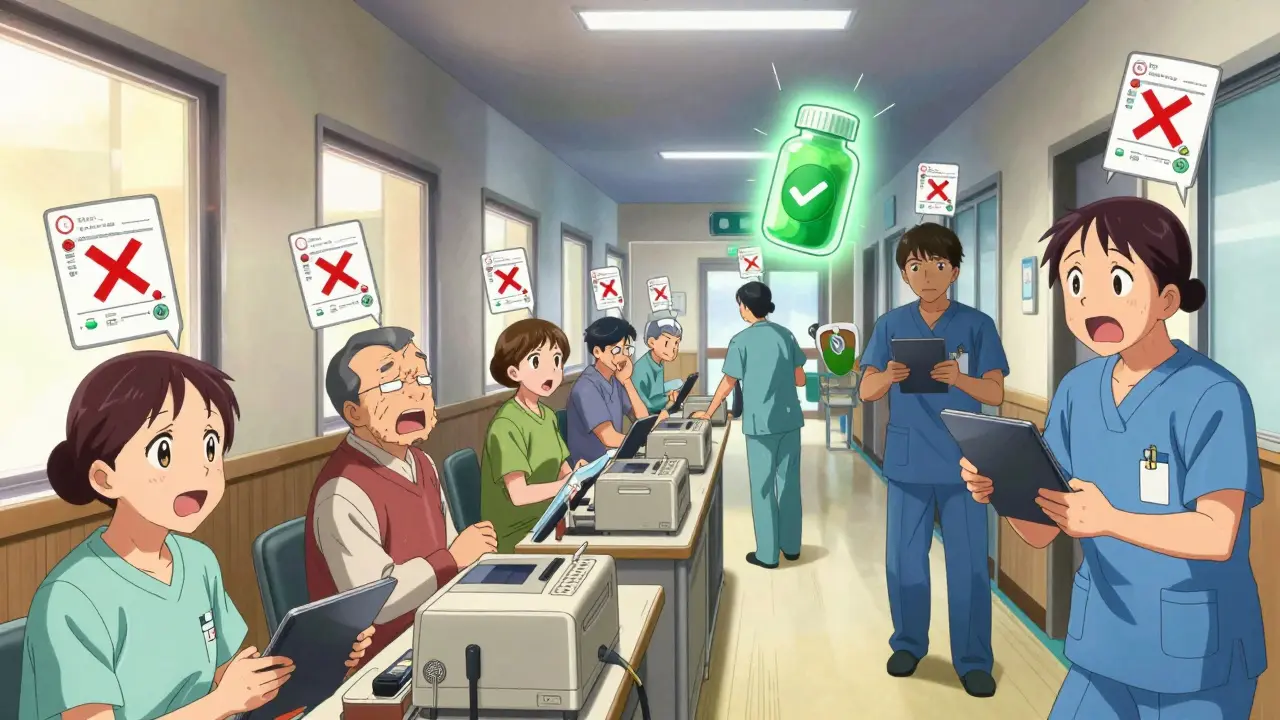
A 2019 survey found that nursing homes spend 10 to 15 hours per week just managing drug coverage issues. That’s over 750 hours a year per facility. Staff time alone costs an average of $28,500 annually. That’s money that could go toward hiring more nurses or improving meals. Instead, it’s going to paperwork, phone calls, and fax machines.
Some facilities have tried to fix this with software that links directly to Part D formularies. The best ones cut down the time it takes to get a drug from 3.2 days to less than a day. But not everyone can afford that tech. Smaller homes? They’re still stuck in the 1990s.
What happens when the drug isn’t covered?
Imagine your mom needs a generic anticoagulant - a blood thinner - to prevent clots after a stroke. Her doctor prescribes it. But her Part D plan doesn’t cover it. Maybe they think a different drug is cheaper. Maybe they just didn’t include it.
Now, she has to wait. She might go without. Or her family has to pay out of pocket. Or her doctor has to fill out paperwork for a prior authorization. That process can take days. In a nursing home, where someone’s health can change overnight, a delay can mean a fall, a hospital trip, or worse.
There’s a loophole: residents can get non-formulary drugs for up to 180 days. But plans aren’t required to honor that. Many don’t. And if you’re not enrolled in Part D at all? You’re out of luck. No exceptions. No help. That’s why nearly 9% of nursing home residents still pay for all their meds themselves.
The new rules changing the game
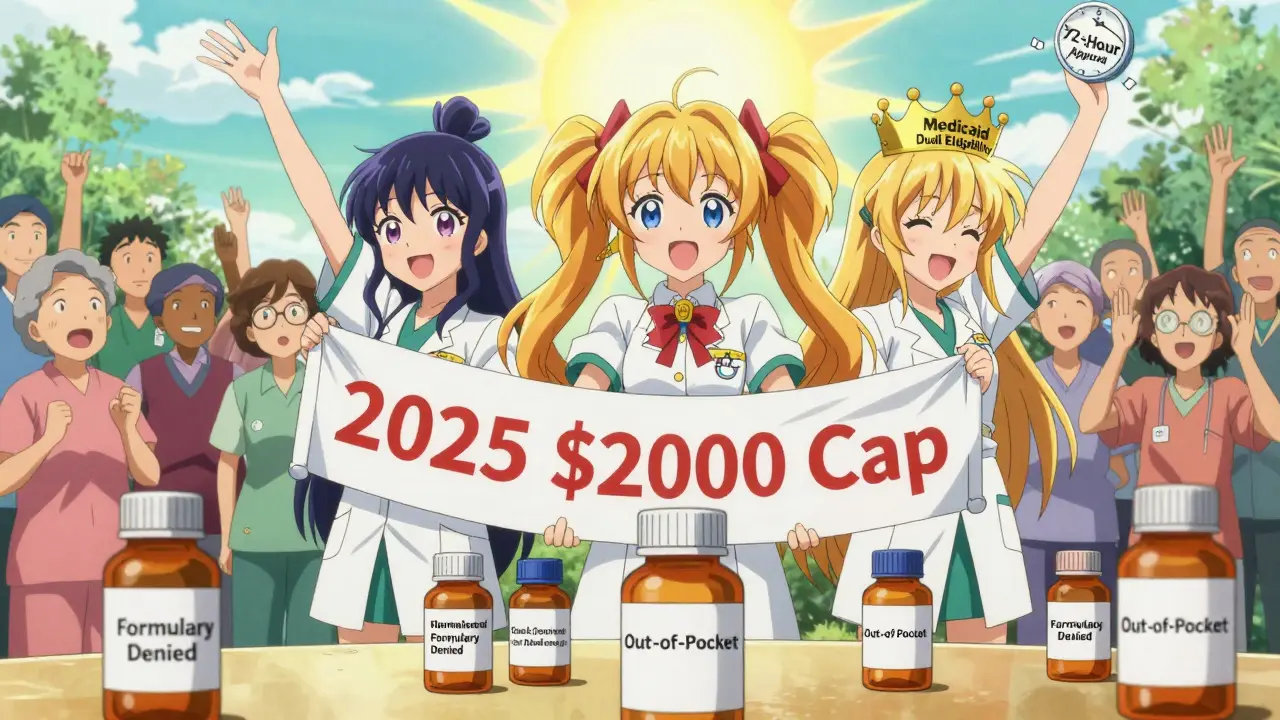
Good news: things are starting to shift. The Inflation Reduction Act of 2022 made big changes, but they don’t kick in until 2025. Starting then, Medicare Part D beneficiaries won’t pay more than $2,000 a year out of pocket for drugs. That’s huge. And vaccines? They’ll be free.
Also in 2021, CMS mandated that Part D plans must cover all drugs on the Medicare Part D Formulary for nursing home residents. No more cherry-picking. And if a drug isn’t covered, the plan has to approve a request within 72 hours. That’s faster than most people can get a doctor’s appointment.
But here’s the problem: these rules don’t fix the root issue. The system is still broken. There are still too many plans. Too many formularies. Too much confusion. And in rural areas, 22% of nursing homes can’t find a pharmacy that works with all the major Part D plans. That means residents go without.
What you need to do now
If you’re choosing a nursing home for someone, ask these questions before they move in:
- What Medicare Part D plan are they enrolled in? If they don’t have one, help them sign up.
- Does the nursing home work with a long-term care pharmacy that contracts with their plan? If not, they might face delays or higher costs.
- What’s the formulary? Ask for a copy. Make sure the drugs they’re taking are covered.
- What’s the process if a drug isn’t covered? Can they get an exception? How long does it take?
- Are they eligible for Medicaid? Dual-eligible residents (Medicare + Medicaid) often get better drug coverage.
Don’t assume everything’s covered. Don’t trust the facility to handle it all. Take control. Call the Part D plan directly. Ask for the formulary. Ask about exceptions. Document everything.
The bigger picture: Why this matters
Generic drugs are the backbone of nursing home care. They’re safe, effective, and affordable. But if the system keeps treating them as an afterthought - if formularies block access, if plans refuse to cover them, if residents pay out of pocket - then we’re not just failing in logistics. We’re failing in care.
By 2028, Medicare Part D will cover over 85% of nursing home drug spending. That’s progress. But the 15% left behind? They’re the ones who get forgotten. The ones without enough money. The ones without family to advocate. The ones in rural towns with no nearby pharmacies.
Long-term care insurance doesn’t cover drugs. That’s the rule. But you don’t have to accept the gaps. Know your options. Push for coverage. Demand transparency. Because no one should go without their meds because the system got too complicated.
Does long-term care insurance cover generic drugs in nursing homes?
No, long-term care insurance does not cover prescription drugs - including generic medications. It only covers custodial care like help with bathing, dressing, and eating. Drug coverage is handled separately, usually by Medicare Part D, Medicaid, or private health insurance.
Who pays for prescription drugs in nursing homes?
Medicare Part D covers about 82% of prescription drug costs for nursing home residents. Medicaid covers about 11%, private insurance covers 8.5%, and the VA covers less than 1%. About 9% of residents pay out of pocket or rely on temporary assistance.
What is a formulary, and why does it matter?
A formulary is a list of drugs a health plan agrees to cover. If a drug isn’t on the list, the plan may refuse to pay - even if it’s generic and medically necessary. Nursing home residents must check their Part D plan’s formulary to ensure their medications are covered, or they may face delays, higher costs, or no access at all.
Can a nursing home resident get a drug that’s not on the formulary?
Yes, but it’s not guaranteed. Part D plans must allow exceptions, and for nursing home residents, they must approve non-formulary requests within 72 hours. However, plans are not required to cover non-formulary drugs beyond 180 days. Some refuse to do so, especially if the drug is expensive or not on their preferred list.
What should families do if a needed drug isn’t covered?
First, contact the Part D plan directly to request an exception. Ask for a written denial if it’s denied. Then, work with the nursing home’s pharmacy liaison or social worker to explore alternatives - including switching to a different Part D plan during open enrollment, applying for Medicaid, or seeking patient assistance programs. Never assume the facility will handle it for you.
Will the $2,000 out-of-pocket cap in 2025 fix this problem?
It will help, but not solve everything. The $2,000 cap means residents won’t pay more than that per year for drugs - a major relief. But it doesn’t fix formulary restrictions, pharmacy access issues, or the administrative burden on nursing homes. It also doesn’t help those without Part D enrollment. So while it’s a step forward, systemic gaps remain.



Michelle Jackson
March 20, 2026 AT 21:45So let me get this straight - we’ve got a system where old people are stuck waiting days for a $2 generic pill because some insurance company’s formulary doesn’t include it? And we call this healthcare? I’m not mad, I’m just disappointed. No emoticons. Just facts.
Suchi G.
March 21, 2026 AT 09:28It’s heartbreaking really, the way we treat our elders in this country - not just here but globally. I’ve seen my aunt in Delhi, she’s 78, and she pays out of pocket for her insulin because the system here doesn’t care about dignity. In the U.S., at least there’s Medicare Part D, but even that’s a labyrinth. Who designed this? Someone who never held a trembling hand while helping someone swallow a pill? The bureaucracy is a machine that grinds people into dust, and we’re all just watching. I don’t know how you sleep at night knowing someone’s life depends on whether a formulary has a tick next to a drug name.
becca roberts
March 22, 2026 AT 14:41Oh wow, so long-term care insurance doesn’t cover drugs? Shocking. Like, who knew? Next you’ll tell me that water is wet and gravity exists. But hey, at least we’re getting to the point where we’re *finally* admitting the truth - that this whole system is a glorified game of telephone where the prescription gets lost somewhere between the doctor’s office and the fax machine. And don’t even get me started on the 10 hours a week nursing homes waste on paperwork. Imagine if that time went to actual care. Or better yet - imagine if we just made it simple. But no, capitalism. Of course.
Andrew Muchmore
March 22, 2026 AT 15:03Medicare Part D covers 82% of nursing home drug costs. That’s the number. Everything else is noise. Families need to check formularies before admission. No excuses. Stop assuming. Do the work.
Paul Ratliff
March 23, 2026 AT 14:59generic drugs = cheaper, same effect, but somehow still a hassle? wild. why do we make this so hard? just make em all covered. simple.
SNEHA GUPTA
March 25, 2026 AT 02:59There’s something deeply philosophical about how we outsource human dignity to bureaucratic forms. The fact that a person’s access to medicine hinges on whether a drug is on a list - a list written by corporate actuaries with no bedside experience - speaks to a civilization that values cost efficiency over compassion. We’ve turned care into a spreadsheet. And yet we pretend we’re advanced. The irony is not lost on me: we can land probes on Mars but can’t ensure an elderly woman gets her blood pressure pill on time. Perhaps the real crisis isn’t policy - it’s our collective moral numbness.
Gaurav Kumar
March 26, 2026 AT 08:59USA has the most advanced healthcare system in the world - no other country even comes close. And yes, there are hiccups, but let’s be real - India’s system is a joke. No formularies, no insurance, just chaos. At least here you have Part D. You have options. You have lawyers. You have *choice*. Stop whining. If your family can’t navigate a 3-page form, that’s their problem. We don’t need socialism. We need accountability. And maybe a little less drama.
David Robinson
March 28, 2026 AT 01:02So let’s say your mom’s on a plan that doesn’t cover her blood thinner. You wait 5 days. She falls. Hospital. $15k bill. Now the system says, 'Oh we’ll cover it now.' But what about the broken hip? The trauma? The lost weeks? You think a 72-hour approval window fixes that? Nah. It’s just a Band-Aid on a hemorrhage. And don’t even get me started on rural homes with no pharmacy contracts. They’re not broken. They’re abandoned. And nobody cares. Because old people don’t vote. Or they vote wrong. Or they’re not profitable. Pick your reason. The outcome’s the same.