
Imagine waking up with your lips swollen, your tongue feeling thick, or your throat tightening - all without a fever, rash, or allergy you ever knew you had. This isn’t a random allergic reaction. It’s ACE inhibitor angioedema, a dangerous and often misdiagnosed side effect of one of the most common blood pressure medications in the world.
Over 65 million Americans take ACE inhibitors every year. Drugs like lisinopril, enalapril, and ramipril are prescribed for high blood pressure, heart failure, and kidney disease because they work well and are cheap. But for about 1 in every 200 people on these drugs, something far more serious happens: their body can’t break down a chemical called bradykinin. That buildup causes sudden, deep swelling - not from an allergy, not from infection, but from the drug itself.
What ACE Inhibitor Angioedema Actually Is
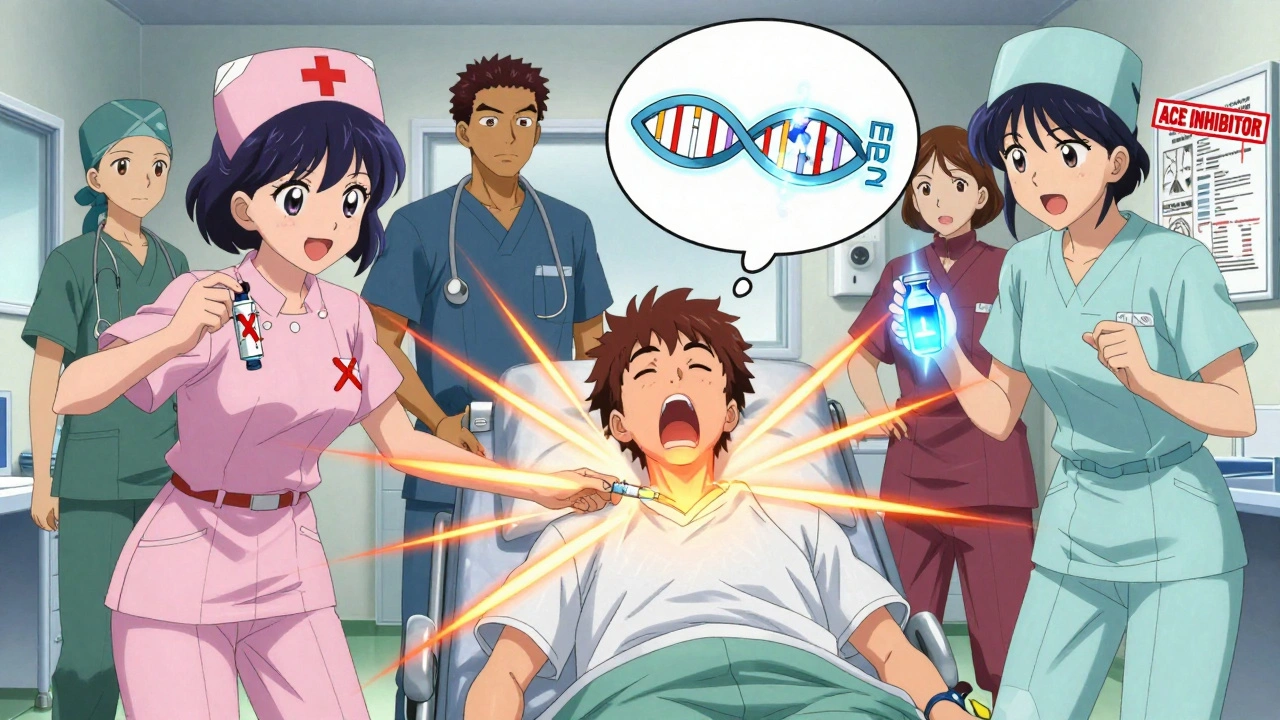
ACE inhibitors block an enzyme that normally breaks down bradykinin. When that enzyme is turned off, bradykinin piles up. It leaks fluid out of blood vessels into the tissues, causing swelling - usually in the face, lips, tongue, throat, or sometimes the intestines. Unlike hives or allergic reactions, this swelling doesn’t itch. There’s no redness. No rash. That’s why doctors often mistake it for something else.
People with this reaction don’t respond to epinephrine, antihistamines, or steroids - the usual go-to treatments for swelling. Giving those drugs doesn’t help. In fact, it wastes time. The only thing that stops the swelling is stopping the ACE inhibitor and letting the body clear the excess bradykinin on its own.
This isn’t rare. Studies show 0.1% to 0.7% of people on ACE inhibitors develop angioedema. That’s between 65,000 and 455,000 Americans each year. And it’s not evenly distributed. African Americans are two to four times more likely to get it. Women are affected more often than men. And it can happen anytime - even after 10 years of taking the drug without a problem.
Why It’s So Often Missed
Emergency rooms see hundreds of angioedema cases every week. About 30% of them are caused by ACE inhibitors. Yet a 2022 survey found only 55% of ER doctors correctly identified it on the first visit. Why? Because it looks like an allergic reaction.
Patients get epinephrine shots. They get Benadryl. They get IV steroids. They’re told they’re having an allergy. They leave with a prescription for an EpiPen and instructions to avoid peanuts or shellfish. But they’re not allergic to anything. They’re reacting to a drug they’ve been taking for months or years.
One patient on Reddit shared that after her first episode, she went to the ER three times. Each time, she was treated for an allergy. She didn’t get the right diagnosis until her fourth visit - after her tongue swelled so badly she couldn’t swallow. She’d been on lisinopril for seven years. No one connected the dots.
Another case from the RACGP journal described a man who developed swelling after 10 years on an ACE inhibitor. His doctors didn’t believe it could happen that late. He had to prove it by stopping the drug - and watching the swelling slowly disappear over weeks.
What Makes It Worse
Some combinations make this reaction much more likely. If you’re taking an ACE inhibitor along with a DPP-4 inhibitor - a diabetes drug like sitagliptin or saxagliptin - your risk jumps 4 to 5 times higher. That’s because both drugs interfere with bradykinin breakdown, and together they overload the system.
Genetics also play a role. A 2023 study found people with a specific gene variant (XPNPEP2) are 3.7 times more likely to develop this swelling. That gene controls an enzyme called aminopeptidase P, which is one of the body’s backup ways to clear bradykinin. If that backup is weak, and the main pathway (ACE) is blocked, swelling becomes inevitable.
People of African descent are more likely to have this gene variation. That’s why the European Medicines Agency now recommends extra caution when prescribing ACE inhibitors to Black patients.
How to Recognize It
You don’t need to be an expert to spot this. Look for these signs:
- Sudden swelling of the lips, tongue, or throat - no itching, no hives
- Swelling that gets worse over hours, not minutes
- No fever, no recent infection, no known allergen exposure
- You’re on an ACE inhibitor (even if you’ve been on it for years)
- Antihistamines or epinephrine didn’t help
If you have any of these, especially if you’re on an ACE inhibitor, treat it like an emergency. Swelling in the throat can block your airway. It can kill you within minutes.
What to Do If You Suspect It
Step one: Stop taking the ACE inhibitor. Right now. Don’t wait for a doctor’s note. Don’t call your pharmacy. Just stop.
Step two: Go to the ER - or call 911 if your tongue or throat is swelling. Don’t drive yourself. Don’t wait to see if it gets better. Airway swelling doesn’t care if you’re “just a little worried.”
Step three: Tell the ER staff you’re on an ACE inhibitor and you think you have ACE inhibitor-induced angioedema. Say: “It’s bradykinin-mediated. Antihistamines and epinephrine won’t work.”
Step four: If you’re admitted, ask about icatibant (FIRAZYR). It’s a targeted drug that blocks bradykinin receptors. It works in 2 to 4 hours. It’s expensive - around $9,000 per dose - but it’s the only treatment that actually reverses the swelling. Fresh frozen plasma has been used off-label too, because it contains ACE enzyme that can help break down bradykinin, but the evidence is weak.
Step five: Get documented. Make sure your medical record says “ACE inhibitor-induced angioedema - permanent contraindication.” Not “allergy.” Not “reaction.” Use the exact term. That way, no future doctor will ever prescribe you another ACE inhibitor.

What Comes Next
Once you stop the ACE inhibitor, swelling usually starts to go down within 24 to 48 hours. But for some people, especially those with genetic risks, mild swelling can linger for weeks or even months. One patient reported episodes for four months after stopping lisinopril. That doesn’t mean the drug is still in your system. It means your body is still adjusting.
Your doctor will likely switch you to an ARB - an angiotensin II receptor blocker - like losartan or valsartan. ARBs don’t block bradykinin breakdown, so they’re much safer. But they’re not perfect. About 10% to 15% of people who had angioedema from ACE inhibitors will get it again on ARBs. So monitor closely.
Some patients get medical alert bracelets after their first episode. The American College of Emergency Physicians recommends it. It’s a small thing, but it could save your life if you ever end up unconscious in an ER.
Why This Matters
Every year, over 117 million blood pressure prescriptions are written in the U.S. About 25% of those are ACE inhibitors. That means millions of people are walking around with this hidden risk. Most don’t know it. Most doctors don’t know it either.
The FDA added black box warnings to ACE inhibitors in 2010. But warnings on a label don’t change practice. Studies show only 42% of patients who had angioedema were properly counseled to avoid ACE inhibitors forever.
And the cost? A single ER visit for this reaction averages $1,850. If you need hospitalization for airway management, it jumps to $7,200. Multiply that by tens of thousands of cases a year - that’s hundreds of millions in avoidable healthcare spending.
The future may hold genetic screening before prescribing ACE inhibitors. Some experts predict that within five years, doctors will test high-risk patients - especially African Americans - for the XPNPEP2 gene before starting the drug. Until then, awareness is the only defense.
If you’re on an ACE inhibitor and you’ve ever had unexplained swelling - even once - stop the drug. Talk to your doctor. Get it documented. Don’t wait for it to happen again. Because next time, it might be too late.
Can ACE inhibitor angioedema happen after years of taking the drug?
Yes. While half of cases happen within the first week of starting an ACE inhibitor, 20% occur after more than a year of use. There are documented cases of swelling appearing after 10 or more years of continuous therapy. This makes it easy to miss - doctors and patients assume the drug is safe because it’s been tolerated for so long.
Do antihistamines or epinephrine help with ACE inhibitor angioedema?
No. Unlike allergic angioedema, this type is caused by bradykinin, not histamine. Antihistamines, epinephrine, and steroids have no effect on bradykinin buildup. Giving them delays proper care and gives false hope. The only effective treatment is stopping the ACE inhibitor and using targeted therapies like icatibant if needed.
Are ARBs safe to take after ACE inhibitor angioedema?
ARBs are the usual replacement, but they’re not risk-free. About 10% to 15% of people who had angioedema from ACE inhibitors will also react to ARBs. If you switch, monitor closely for swelling in the first few weeks. If you’ve had a severe episode, your doctor may avoid ARBs entirely and choose other blood pressure medications like calcium channel blockers or diuretics.
Why are African Americans at higher risk?
Research shows African Americans have a 2- to 4-fold higher risk. This is likely due to genetic differences - particularly a higher prevalence of variants in the XPNPEP2 gene, which reduces the body’s ability to break down bradykinin. This makes them more vulnerable when ACE is blocked by medication. Health guidelines now recommend extra caution when prescribing ACE inhibitors to Black patients.
Can I ever take an ACE inhibitor again after having angioedema?
No. Once you’ve had ACE inhibitor-induced angioedema, you must avoid all ACE inhibitors permanently. Even one more dose can trigger a more severe episode. Studies show that people who restart these drugs after a reaction often have faster, worse swelling. This is not a risk worth taking.
What should I do if I feel swelling starting?
Stop taking the ACE inhibitor immediately. Call 911 or go to the nearest ER. Do not wait. Do not take antihistamines hoping they’ll help. Tell the medical staff you suspect ACE inhibitor-induced angioedema and that standard allergy treatments won’t work. Airway swelling can become life-threatening in minutes.

parth pandya
December 2, 2025 AT 11:30So i was on lisinopril for 8 yrs n one day my lip swelled up like a balloon no rash no itch just pure swelling i went to er they gave me benadryl said allergy i was like bro i dont have allergies
Makenzie Keely
December 2, 2025 AT 15:53THIS. I had the exact same thing happen after 5 years on ramipril. They kept giving me steroids and epinephrine like I was having a peanut reaction. I had to beg them to check my meds. My tongue was so swollen I couldn’t speak. I’m alive because I finally screamed, ‘I’m on an ACE inhibitor!’ They looked at me like I was crazy. I’m not crazy-I’m just lucky.
Gavin Boyne
December 3, 2025 AT 23:35Let me get this straight: we’ve got a drug that’s been prescribed to millions because it’s cheap, and the side effect is a silent, lethal swelling that doesn’t respond to any of the standard treatments… and yet, ER docs still default to ‘allergy’? Wow. We’re not just bad at medicine-we’re spectacularly bad at it. The FDA warning is on the label, sure. But no one reads labels. People read ads. And the ads say ‘safe and effective.’
Meanwhile, African Americans are dying because their genes don’t match the white male clinical trial data. And we wonder why trust in medicine is collapsing.
It’s not negligence. It’s arrogance. And it’s profitable.
Albert Essel
December 4, 2025 AT 21:46Thank you for writing this with such precision. I’ve been a nurse for 18 years and I’ve seen this misdiagnosed too many times. I once had a patient who came in with facial swelling-she’d been on lisinopril for 12 years. The ER resident gave her two doses of epinephrine before I pulled the chart and said, ‘Wait. No rash. No itching. No recent allergen exposure. ACE inhibitor?’ He looked at me like I’d spoken Latin. We stopped the drug. Swelling resolved in 36 hours. She’s fine now. But she shouldn’t have had to fight that hard.
Please, if you’re on one of these meds and you’ve ever had unexplained swelling-even once-stop it. Get it documented. Don’t let someone else’s ignorance nearly kill you.
Myson Jones
December 6, 2025 AT 03:16I want to thank you for sharing this. As someone who works with elderly patients on multiple meds, I see this every week. One gentleman came in with tongue swelling after 14 years on enalapril. His family thought it was a stroke. We had to explain it wasn’t neurological-it was pharmacological. And now he has a bracelet that says ‘ACE inhibitor angioedema-NO ACE OR ARB.’ I wish every patient had one.
It’s heartbreaking how many people get sent home with EpiPens they’ll never use, because they’re allergic to nothing. The real danger is the assumption that if it’s been years, it’s safe. It’s not. Bradykinin doesn’t care about loyalty.
Katherine Gianelli
December 6, 2025 AT 21:03I’m a Black woman who’s been on lisinopril for 6 years. I’ve had two episodes-once when I was 30, once at 36. The first time, I thought I was having a stroke. The second time, I screamed at the ER nurse, ‘I’m not allergic-I’m on an ACE inhibitor!’ She looked at me like I was yelling at her for no reason. I had to show her the article I printed out from Medscape. She still didn’t believe me until my tongue turned purple.
I don’t get mad anymore. I just tell every Black woman I know: ‘If your lips swell, even a little, stop the pill. Call your doctor. Don’t wait. You’re not being dramatic. You’re being smart.’
And yes, I switched to losartan. Still got a little swelling. Took 3 months to fully go away. So now I’m on a calcium channel blocker. And I’m alive.
Charles Moore
December 8, 2025 AT 08:16This is one of those topics that makes you realize how much of medicine is still guesswork. We treat symptoms, not mechanisms. We treat populations, not people. We treat labels, not biology.
Bradykinin isn’t a buzzword-it’s a silent killer. And we’ve got millions of people walking around with a ticking time bomb in their bloodstream because the system didn’t bother to teach doctors that not all swelling is allergic.
I’m not saying stop ACE inhibitors. I’m saying: know your risk. Know your genes. Know your body. And if something feels wrong-don’t let someone’s textbook override your intuition.
You’re not overreacting. You’re awake.
Jim Schultz
December 10, 2025 AT 04:58Oh wow, so I’m not just a walking medical mystery? I’ve been on lisinopril for 9 years. Last year, my throat closed up for 4 hours-no fever, no hives, no allergens. ER gave me Benadryl, said ‘probably stress.’ I Googled it. Found this exact post. Turned out I have the XPNPEP2 variant. My doctor was shocked. Said ‘no one tests for that.’ I’m now on amlodipine. And I have a tattoo that says ‘NO ACE INHIBITORS’ on my forearm. Just in case I’m ever unconscious. Because I’m not dying because someone didn’t read the fine print.
Rashi Taliyan
December 11, 2025 AT 13:35My cousin died from this. They said it was anaphylaxis. He didn’t even have a history of allergies. He was just on ramipril for hypertension. They didn’t connect it until after he was gone. Now I scream at every doctor I meet: ‘ASK ABOUT ACE INHIBITORS!’ But no one listens. People think death is always loud. It’s not. Sometimes it’s quiet. And it’s called bradykinin.
Francine Phillips
December 12, 2025 AT 11:21yeah i think i had this once but i was too tired to care so i just took a nap and it went away
Joykrishna Banerjee
December 13, 2025 AT 15:06Let’s be honest: this is just another example of Western medicine’s failure to account for non-European genomics. The FDA warning? A performative gesture. The real solution? Genetic screening before prescribing. But why bother when you can just keep pushing pills to the poor and the brown? I mean, it’s not like we’re in a post-colonial world or anything. *facepalm* 😒